
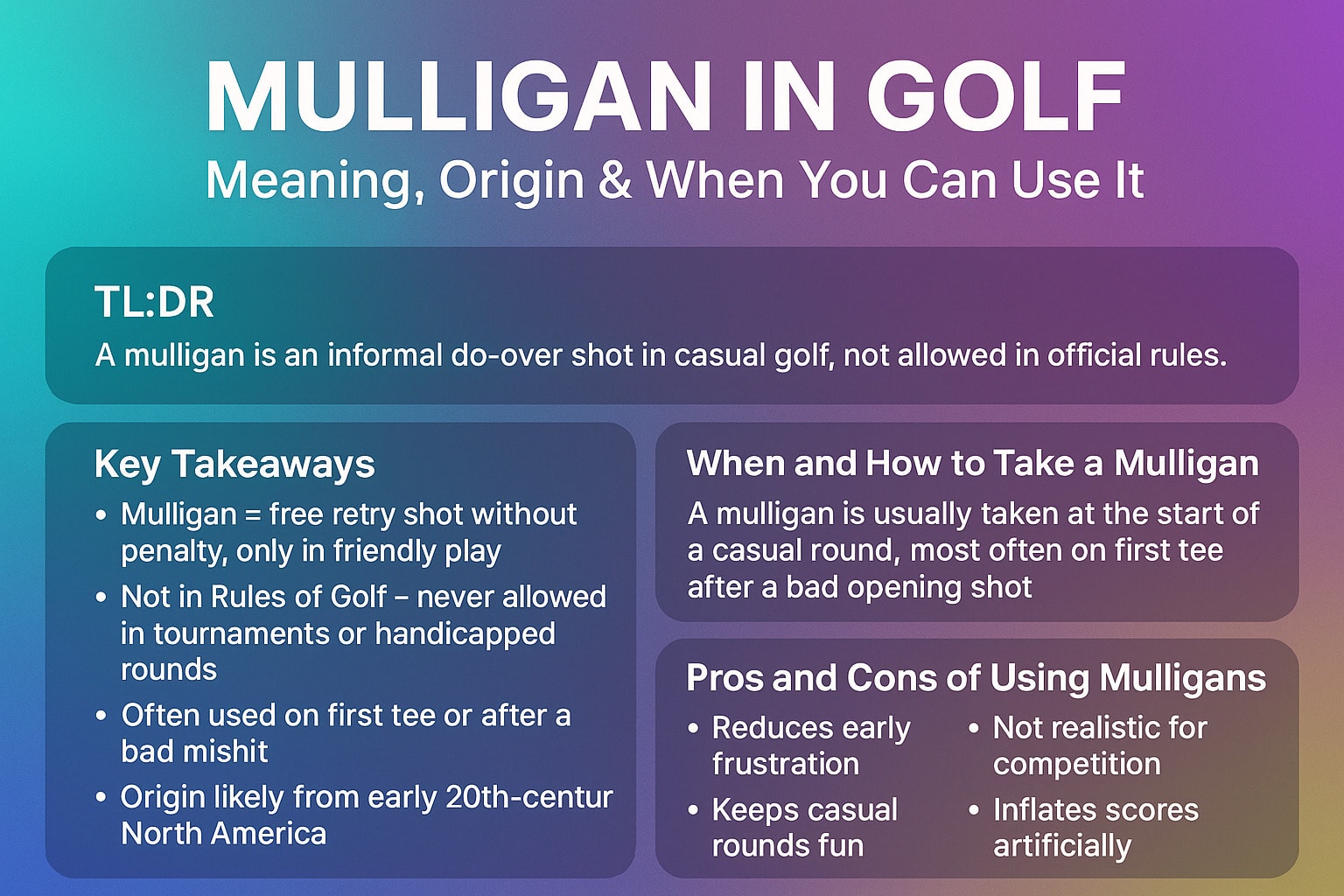
TL;DR
A mulligan is an informal do-over shot in casual golf, not allowed in official rules.
Key Takeaways
- Mulligan = free retry shot without penalty, only in friendly play.
- Not in Rules of Golf – never allowed in tournaments or handicapped rounds.
- Often used on first tee or after a bad mishit.
- Origin likely from early 20th-century North America.
- Always confirm with group before taking one.
What Is a Mulligan in Golf?
A mulligan in golf is an unofficial “do-over” shot that lets a player retake a stroke without adding a penalty.
It’s purely a courtesy in friendly rounds, often granted after a bad tee shot, and is never recognized in the official Rules of Golf.
Most mulligans happen on the first tee or in casual games where the group agrees beforehand. They’re meant to keep the mood fun and relaxed, not to post an accurate score for handicap or competition.
Is a Mulligan Legal in Golf?
No, a mulligan is not legal in golf under the official Rules of Golf.
The governing bodies (USGA and R&A) do not recognize mulligans, so they are never allowed in:
- Tournaments
- Handicap rounds
- Any round where the score is meant to be official
In casual or friendly play, groups can agree to allow mulligans, but these scores are considered non-official and can’t be submitted for handicap purposes.

They’re purely for fun and to keep the game moving when everyone’s on board.
Origin of the Term “Mulligan”
The exact origin of the term “mulligan” isn’t certain, but there are a few popular theories golfers still debate, most notably the David Mulligan Theory, the Hotelier Mulligan Theory, and the Irish-American Slang Theory.
- David Mulligan Theory: The most common story credits David Bernard Mulligan, a Canadian amateur golfer in the 1920s. After hitting a poor opening drive at his club in Montreal, he re-teed and jokingly called it a “correction shot,” which his friends later dubbed a “Mulligan.”
- Hotelier Mulligan Theory: Another version says a hotel manager named Mulligan in New York took a second tee shot after arriving late and flustered, and his playing partners good-naturedly named the do-over after him.
- Irish-American Slang Theory: Some suggest it comes from Irish-American slang, where “Mulligan” was used as a nickname for a mix-up or do-over, and it simply stuck in golf culture.
Regardless of which story is true, the term spread across North America in the early 20th century, eventually making its way into other sports and everyday language to mean any second chance without penalty.
When and How to Take a Mulligan
A mulligan is usually taken at the start of a casual round, most often on the first tee after a bad opening shot. It’s meant to keep the game relaxed and fun, not to boost an official score.
Typical etiquette and tips:
- Agree with your group beforehand: Make sure everyone knows and accepts the mulligan rule for the day.
- Limit usage: Common house rules allow one mulligan per round or one per nine holes.
- Take it immediately: A mulligan must be played right after the original shot, from the same spot.
- Never take a mulligan without announcing it: Silent do-overs are poor etiquette.
- No score padding: If you’re posting a score for handicap purposes, don’t count mulligans, they make the round non-official.
Many golfers also call a first-tee mulligan a “breakfast ball,” especially in morning rounds.
Pros and Cons of Using Mulligans
Using mulligans in golf can reduce early frustration, keep casual rounds fun, and boost confidence, but they’re also unrealistic for competition, inflate scores artificially, and slow down play.
Pros of Using Mulligans
- Reduces early frustration: Lets you recover from a poor start, especially on the first tee.
- Keeps casual rounds fun: Encourages a relaxed, social atmosphere.
- Boosts confidence: A second try can help settle nerves.
Cons of Using Mulligans
- Not realistic for competition: Can create bad habits that don’t work under official rules.
- Inflates scores artificially: Gives a misleading sense of performance.
- Can slow down play: Too many mulligans disrupt pace if overused.
In short, mulligans are great for friendly games, but relying on them too much can hurt your real-game performance.

Mulligan Variations and Nicknames
Common mulligan variations and nicknames include the Breakfast Ball, Lunch Ball, Do-Over, Second Chance, and Provisional Mulligan.
- Breakfast Ball: A mulligan taken on the first tee of a morning round.
- Lunch Ball: A playful second-chance shot during an afternoon round.
- Do-Over: A casual, non-golf-specific term for retaking a shot.
- Second Chance: Another friendly term for a mulligan, used both in and outside golf.
- Provisional Mulligan: A joking term for taking yet another mulligan after the first one (not recommended!).
FAQs about Mulligans in Golf
Can you use a mulligan in a tournament?
No. Mulligans are not allowed under the official Rules of Golf and cannot be used in tournaments or handicap rounds.
When is a mulligan typically taken?
Most often on the first tee after a bad opening shot, but only in casual play with group approval.
Does a mulligan count as a stroke?
In casual play, the first shot is ignored and replaced with the mulligan. In official play, the original stroke always counts.
Why is it called a “mulligan”?
The name’s origin is debated, with popular theories including the David Mulligan Theory, Hotelier Mulligan Theory, and Irish-American Slang Theory.
What’s the difference between a mulligan and a provisional ball?
A mulligan is a free do-over in friendly play, while a provisional ball is an official Rules of Golf option used when a ball may be lost or out of bounds, and it always counts if played.
Get instant access to the PDF version of this article with additional resources and insights.