
TL;DR
Straight shots start and finish on your target line, hard to repeat because clubface and swing path must be perfectly square.
Key Takeaways
- Straight = no curve, requires square path + face.
- Even pros rely on slight draws/fades for control.
- Use straight shots on tight lines; curve it elsewhere.
- Six-step setup (neutral grip → clubface control) is your blueprint.
- Alignment & path drills are easiest ways to groove it.
What Is a Straight Shot in Golf?
A straight shot in golf is a ball that starts on your target line and flies without curving.
It happens when both the clubface and swing path are square to the target at impact, resulting in a perfectly straight flight from start to finish. While it’s ideal, even skilled players rarely hit a true straight shot consistently due to the precision required.

Why a Straight Shot Is So Difficult
A straight shot is difficult because it requires your clubface and swing path to be perfectly aligned at impact, a rare and precise combination.
Straight shots are hard to hit consistently due to small margin for error, natural swing path tendencies, body alignment issues, clubface control challenges, and external factors like wind or slope.
- Tiny margin for error: Even a 1–2° mismatch between path and face causes a draw or fade.
- Natural tendencies: Most golfers naturally swing slightly in-to-out or out-to-in.
- Body alignment issues: Poor stance, posture, or shoulder alignment shifts the swing path.
- Face control challenges: It’s hard to keep the clubface square without twisting at impact.
- External factors: Wind, slope, and ball position can influence unintended curve.
Most pros aim for small, repeatable curves (like a baby draw or fade) because trying to hit it dead straight is often less reliable.
When to Use a Straight Shot
Use a straight shot on tight fairways, narrow tee shots, center-pin approaches, punch shots, and recovery shots where accuracy and a neutral ball flight are essential.
- Tight fairways with trouble on both sides (trees, water, OB)
- Narrow tee shots where accuracy matters more than distance
- Approach shots to center pins with minimal green slope
- Punch shots under tree branches or in low-ceiling scenarios
- Recovery shots where side spin could make things worse
When Not to Use a Straight Shot
Avoid forcing a straight shot when a draw or fade offers a better angle, the hole layout favors a curved ball flight, or your natural shot shape is more consistent.
Hitting straight can be smart, but only when it fits the shot and matches your strengths.
How to Hit a Straight Shot
To hit a straight shot, follow these 6 key steps in order: use a neutral grip, set up with square alignment, position the ball centered, maintain balanced posture, swing on a straight path, and control the clubface through impact.
Step 1: Neutral Grip
Avoid strong or weak hand positions to help keep the clubface square at impact.
Step 2: Square Alignment
Align your feet, hips, and shoulders directly at the target to guide a straight path.
Step 3: Centered Ball Position
Place the ball slightly forward of center for irons, and more forward for the driver.
Step 4: Balanced Posture
Maintain a stable base, neutral spine angle, and eyes positioned over the ball.
Step 5: Straight Swing Path
Swing the club directly down the target line, avoid in-to-out or out-to-in motion.
Step 6: Clubface Control
Keep your hands quiet and steady through impact to prevent face rotation.
Consistency in setup and tempo is key to hitting it straight

Drills to Help You Hit Straighter
To hit straighter shots, practice the alignment stick drill, path gate drill, clubface awareness drill, slow-motion swings, straight start line drill, and launch monitor feedback.
1. Alignment Stick Drill
Place two alignment sticks on the ground: one along your target line, one for foot alignment. Practice hitting balls with everything square to the target.
2. Path Gate Drill
Set up two tees or headcovers just wider than your clubhead, a few inches in front of the ball. This helps groove a straight path through impact.
3. Clubface Awareness Drill
Use face tape or foot spray on your clubface to check where you’re striking the ball. Pair this with slow swings to feel square contact.
4. Slow-Motion Swings
Make half-speed swings focusing on staying square at setup and impact. Film yourself or use a mirror for feedback.
5. Straight Start Line Drill
Set a stick or string a few feet ahead of the ball on the target line. Try to launch the ball directly over it — this confirms your path and face are square.
6. Launch Monitor or Video Feedback
Use a launch monitor or video to check face angle and swing path numbers. Look for path and face to be within 1–2° of each other for straight flight.
Straight Shot vs Other Ball Flights
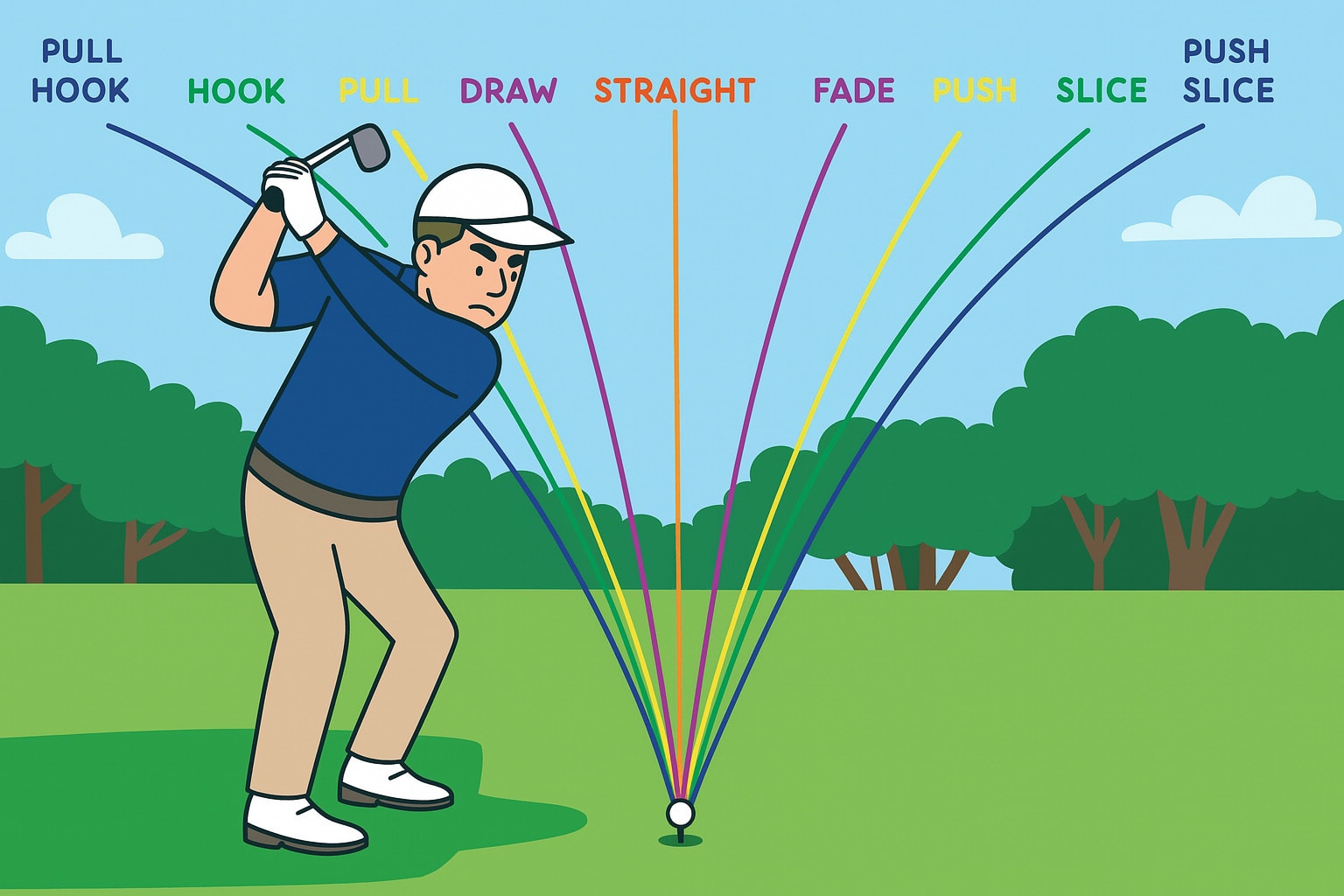
Straight, draw, fade, pull, slice, and hook, here’s how each differs in start direction, curve direction, and common cause.
| Shot Type | Start Direction | Curve Direction | Common Cause |
|---|---|---|---|
| Straight | Target line | None | Square swing path + square clubface |
| Draw | Slightly right (RH) | Left | Inside-out path + slightly closed face |
| Fade | Slightly left (RH) | Right | Outside-in path + slightly open face |
| Pull | Left | None | Outside-in path + square face |
| Slice | Left to right (big curve) | Right | Outside-in path + open clubface |
| Hook | Right to left (sharp) | Left | Inside-out path + closed clubface |
RH = Right-handed golfer
A straight shot is the most precise but hardest to execute, while curved shots are often more reliable and strategic in real play.
Pro Insights: Do Tour Players Hit Straight Shots?
Tour players rarely aim for perfectly straight shots. They typically prefer consistent draws or fades because they’re more repeatable, controllable, and adaptable to course conditions.
Why pros don’t rely on straight shots:
- Small curve adds control: A slight draw or fade helps shape shots around obstacles and control distance.
- Straight shots are high risk: Even minor face or path errors can cause big misses.
- Course strategy: Pros plan shots based on pin position, wind, and green slope — often favoring curves.
- Consistency over perfection: Most pros stick to their natural shot shape under pressure.
Examples:
- Rory McIlroy: Prefers a high draw off the tee.
- Collin Morikawa: Known for a controlled fade with irons.
- Tiger Woods: Shapes shots both ways, but rarely tries to hit it dead straight unless absolutely necessary.
FAQs About Straight Shots in Golf
Do pros ever hit straight shots on purpose?
Rarely, most prefer a slight draw or fade for consistency and control.
Is a straight shot the best shot shape?
Not always. While ideal in theory, it’s harder to repeat than a controlled curve.
Why does my ball curve even when I feel square?
Your swing path or clubface may be slightly off, even 1–2° causes curve.
Can beginners learn to hit straight shots?
Yes, but it takes proper setup, path training, and clubface control.
Should I aim to hit straight or use my natural shot shape?
Play your most repeatable shot shape, straight is great, but consistency wins.
What equipment helps hit straighter shots?
Clubs with more forgiveness, properly fit shafts, and lower-spin balls can help reduce unwanted curvature.
Get instant access to the PDF version of this article with additional resources and insights.