
TL;DR
Stableford rewards under-par holes with points and caps damage from bad holes, making rounds quicker and more aggressive. Highest points win.
Key Takeaways
- Points-based, not stroke-based: birdies = 3 pts, pars = 2 pts, bogeys = 1 pt.
- Handicap-friendly: scores calculated net of handicap strokes.
- Bad holes cost 0 pts: pick up and move on, speeding play.
- Encourages risk-taking: eagles and albatrosses are game-changers.
- Popular in club & charity events: Modified Stableford even appears on the PGA Tour.
What Is Stableford in Golf?
Stableford is a golf scoring system that awards points based on your score relative to par on each hole.
Instead of counting total strokes like in stroke play, Stableford gives you points, more points for better scores (like birdies and eagles) and fewer or zero points for worse ones (like bogeys or double bogeys).
The player with the highest total points at the end of the round wins. This system speeds up play, reduces the impact of bad holes, and encourages more aggressive strategies, especially in casual or club competitions.
How Stableford Scoring Works
Stableford scoring works by awarding points on each hole based on your net score relative to par.
Here’s how the scoring system works:
You earn points instead of counting strokes.
Points are calculated using your net score, which factors in your handicap.
Each hole awards a set number of points based on how well you play compared to par:
- Double bogey or worse (2 or more over par): 0 points
- Bogey (1 over par): 1 point
- Par: 2 points
- Birdie (1 under par): 3 points
- Eagle (2 under par): 4 points
- Albatross (3 under par): 5 points
- Hole-in-one on a par 5 (4 under): 6 points
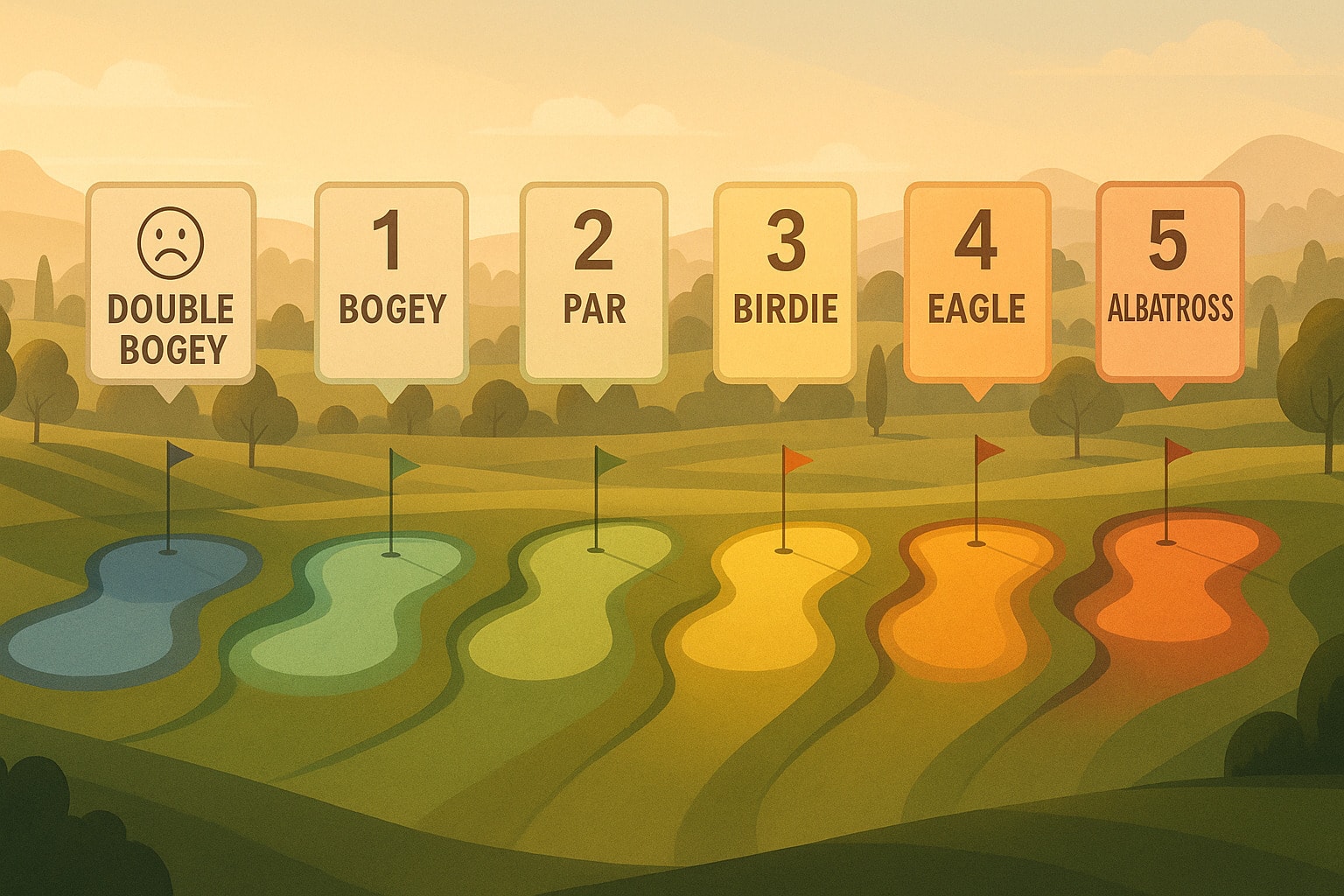
The total score for the round is the sum of all points earned across 18 holes.
The player with the highest total points wins the round.
Stableford rules often allow players to pick up their ball if they can’t score on a hole, making the game faster and less punishing.
Stableford vs Stroke Play
Stableford and stroke play differ in scoring method, objective, handling of bad holes, playing strategy, pace of play, and typical use.
| Aspect | Stableford | Stroke Play |
|---|---|---|
| Scoring Method | Points awarded based on net score relative to par | Total strokes counted over the entire round |
| Objective | Highest total points wins | Lowest total strokes wins |
| Bad Holes | Max loss is 0 points; doesn’t affect total score heavily | Can significantly increase total score |
| Strategy | Encourages aggressive play for birdies/eagles | Rewards consistency and minimizing mistakes |
| Pace of Play | Faster, players can pick up once they can’t score | Slower, players must finish every hole |
| Common Use | Club events, casual play, modified pro events | Most professional and amateur competitions |
In short:
Stableford is more forgiving and faster-paced, making it ideal for casual and club play.
Stroke play, on the other hand, is more demanding and consistent, which is why it’s used in most professional tournaments.
Official Rules of Stableford (Rule 21.1)
Rule 21.1 covers Stableford’s point scale, scorecard requirements, and penalty handling.
Key Points from Rule 21.1:
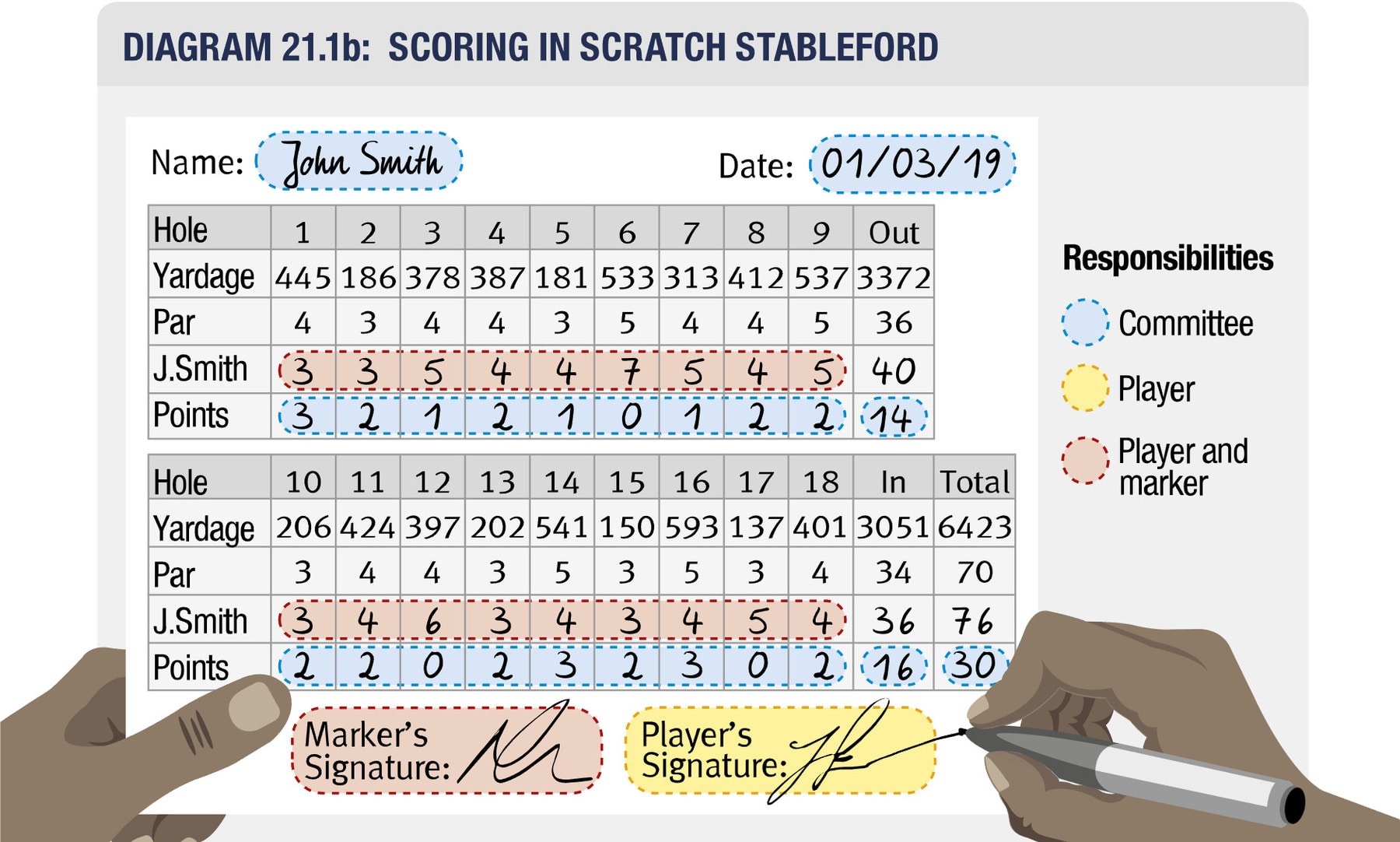
- Form of stroke play where points are awarded on each hole by comparing your score to a fixed target (usually par).
- The player or team with the highest total points at the end of the round wins.
Point System (Standard):
| Score Relative to Target | Points |
|---|---|
| 4 under par (e.g. hole-in-one on a par 5) | 6 |
| 3 under par (albatross) | 5 |
| 2 under par (eagle) | 4 |
| 1 under par (birdie) | 3 |
| Par | 2 |
| 1 over par (bogey) | 1 |
| 2+ over par or no score | 0 |
Additional Rules:
Picking up is allowed once you can’t earn points on a hole, this helps speed up play.
Scorecard entries:
- If you score points: record your actual strokes.
- If you score zero: either leave it blank or record any number resulting in 0 points.
Penalties:
- Penalty strokes are included in your score for that hole.
- For breaches like failing to hole out or playing from the wrong place, you lose points for that hole (0 points) but are not disqualified.
- Disqualification only applies if you break rules that carry a disqualification penalty and fail to report them.
For full details, see: USGA Rule 21.1 – Stableford
Benefits of Playing Stableford
Stableford’s key benefits are damage control, faster rounds, aggressive strategy, lower pressure, handicap fairness, and social appeal.
- Limits damage from bad holes: A poor hole only results in 0 points, so it won’t ruin your entire round.
- Speeds up play: Players can pick up the ball once they can’t earn points, keeping the pace quick.
- Encourages aggressive strategy: Birdies and eagles are highly rewarded, so players are motivated to take more risks.
- Reduces pressure: Each hole is a new scoring opportunity, making it easier to recover mentally.
- Accommodates mixed skill levels: Handicaps allow players of different abilities to compete fairly.
- Enhances casual competition: The format is more relaxed and enjoyable, making it perfect for club and social games.

Stableford Strategy Tips
Effective Stableford strategy involves targeting high-point holes, playing smart around handicap strokes, knowing when to pick up, managing risk, and focusing on scoring opportunities.
- Target high-point holes: Focus on holes where you have a realistic chance at birdie or par to maximize points.
- Use your handicap smartly: Know which holes you get extra strokes on and take full advantage of them.
- Pick up when necessary: If you’re out of position and unlikely to score, pick up and move on to save energy and pace.
- Manage risk vs reward: Take aggressive lines when there’s a big upside (e.g. eagle chances), but don’t gamble when par still gives good points.
- Stay focused on scoring: Treat each hole as a fresh opportunity, don’t dwell on missed points from earlier holes.
Common Formats Using Stableford
Stableford is commonly used in regular club play, social golf events, charity tournaments, modified professional events, and handicap-based competitions.
Regular club play
Many golf clubs use Stableford for weekly or monthly member competitions.
Social golf events
Its forgiving nature makes it ideal for casual games among friends or mixed-ability groups.
Charity tournamentsSpeeds up play and keeps the mood fun and competitive, perfect for fundraising events.
Modified professional eventsThe PGA Tour’s Barracuda Championship uses a modified Stableford format to encourage aggressive play.
Handicap-based competitionsStableford works well with handicaps, allowing fair scoring across skill levels.
Example of Stableford in Action
Here’s a simple example using standard Stableford scoring:
| Hole | Par | Player A (Gross) | Player A (Net) | Score vs Par | Points |
|---|---|---|---|---|---|
| 1 | 4 | 5 | 4 | Par | 2 |
| 2 | 5 | 6 | 5 | Par | 2 |
| 3 | 3 | 4 | 3 | Par | 2 |
| 4 | 4 | 6 | 5 | Bogey | 1 |
| 5 | 4 | 3 | 2 | Birdie | 3 |
| … | … | … | … | … | … |
| Total | 36 |
What This Shows:
- Even if a player has a few bogeys or worse, they can still score well by earning points on strong holes.
- Players are rewarded for under-par holes rather than punished for bad ones.
- The final score is based on total points, not total strokes.
FAQs about Stableford in golf
What is Stableford scoring in simple terms?
Stableford is a points-based scoring system where you earn points on each hole depending on how well you score compared to par, the better you score, the more points you get.
How is Stableford different from stroke play?
In stroke play, you count total strokes and the lowest score wins. In Stableford, you earn points per hole and the highest total points wins.
What happens if I score a double bogey or worse?
You receive 0 points for that hole, but it won’t affect your total score beyond that, unlike stroke play, where every extra stroke counts.
Does Stableford use handicaps?
Yes. Most Stableford competitions are played using net scores, which means your handicap is applied on a hole-by-hole basis.
Can I pick up my ball in Stableford?
Yes. If you can no longer earn points on a hole, you can pick up and move to the next tee to speed up play.
Is Stableford used in professional golf?
Rarely. However, the Barracuda Championship on the PGA Tour uses a Modified Stableford format that awards more aggressive scoring.
Get instant access to the PDF version of this article with additional resources and insights.