
TL;DR
Slice starts left/straight then curves hard right, square the clubface and swing inside-neutral to fix it.
Key Takeaways
- Slice = open face + outside-in path: ball starts left/straight, then curves hard right (right-handers).
- Main causes: weak grip, poor alignment, early extension, forward ball position, ill-fitting gear.
- Quick fix: strengthen grip, square shoulders, swing in-to-out, rotate clubface through impact.
- Best drills: Tee Gate, Headcover, Toe-Up, Trail-hand, groove inside path and face control.
- Equipment tweaks: draw-biased driver, more loft, stiffer shaft, upright lie, low-spin ball.
What Is a Slice in Golf?
A slice in golf is a shot that curves hard to the right (for right-handed players) due to sidespin. It typically starts slightly left or straight, then veers sharply right in flight. This is caused by an open clubface at impact combined with an outside-in swing path.
(For left-handed golfers, the ball curves left instead.)

Why Does a Slice Happen?
A slice happens when the clubface is open at impact, the swing path moves outside-in, the grip is weak, the setup is misaligned, there is early extension, the ball is too far forward, or the equipment doesn’t fit properly.
- Open clubface at impact: The face points right of the swing path at contact, adding sidespin that makes the ball curve right.
- Outside-in swing path: The club cuts across the ball from outside the target line, increasing left-to-right spin.
- Weak grip: Hands are turned too far toward the target, making it hard to close the face before impact.
- Poor alignment or setup: Open shoulders or feet aim you left, promoting an outside-in path and reinforcing a slice.
- Early extension / casting: Standing up or releasing the club too early causes loss of rotation and an open face.
- Ball too far forward: Contact happens too late in the swing arc, leaving the face open and path cutting across.
- Equipment issues: A shaft that’s too soft or a low-lofted driver can increase spin and make slices worse.
Fixing a slice requires addressing both clubface control and swing path direction together.
How to Fix a Slice (Step-by-Step)
A slice can be fixed by strengthening your grip, aligning properly, adjusting ball position, fixing your swing path, rotating the clubface, shifting your weight, maintaining posture, and using the right equipment.
- Strengthen your grip: Rotate your lead hand slightly away from the target to help square the clubface at impact.
- Align properly: Ensure your feet, hips, and shoulders are parallel to the target line—not aiming left.
- Adjust ball position: Move the ball slightly back in your stance to promote better timing and face control.
- Fix your swing path: Practice swinging from the inside with drills like the headcover or alignment stick drill.
- Rotate the clubface: Train clubface rotation through impact using “toe-up” drills to reduce openness at contact.
- Shift your weight: Move your weight to your front foot on the downswing to improve balance and face control.
- Maintain posture: Stay in your spine angle through impact to prevent early extension and path errors.
- Use the right equipment: Consider a draw-biased driver, more loft, or a stiffer shaft to reduce slice spin.
Quick Drills to Cure a Slice
You can cure a slice with the Tee Gate Drill, Headcover Drill, Baseball Swing Drill, Toe-Up Drill, Trail Hand Drill, and Foot-Together Drill.
- Tee Gate Drill: Set two tees just outside your clubhead path, swing through without hitting them to correct swing path.
- Headcover Drill: Place a headcover outside the target line, missing it forces an inside-out path.
- Baseball Swing Drill: Swing the club horizontally at waist height to feel body rotation and reduce over-the-top motion.
- Toe-Up Drill: Make half swings with the toe pointing up after takeaway and after impact, trains face rotation and squareness.
- Trail Hand Drill: Hit short shots using only your trail hand to develop release timing and clubface control.
- Foot-Together Drill: Swing with feet close together to improve balance, tempo, and coordinated movement.

Slice vs. Fade vs. Push-Slice
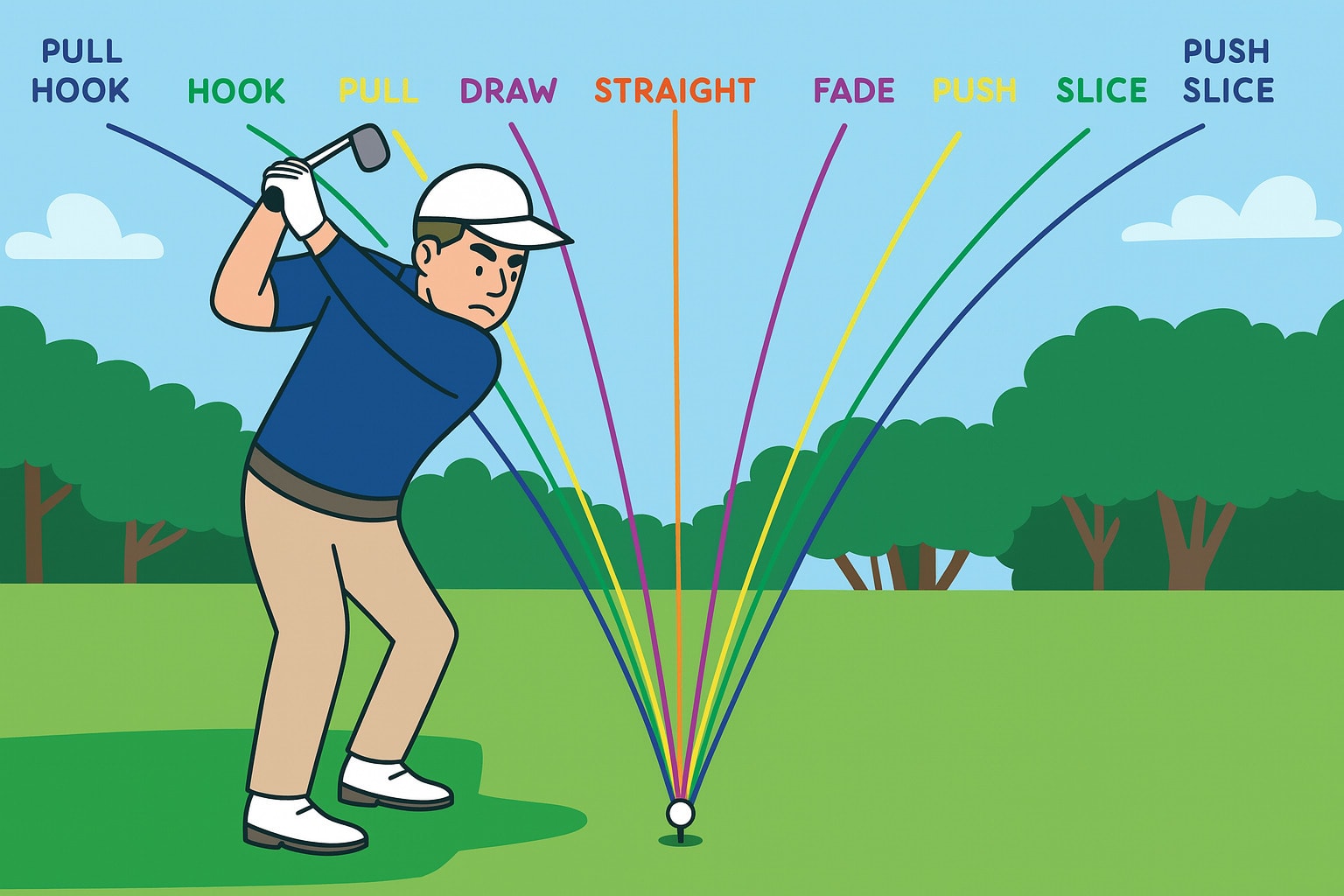
A slice, fade, and push-slice differ in start direction, ball curve, clubface angle, swing path, and intent, even though all curve right for right-handers.
| Shot Type | Start Direction | Ball Curve | Clubface to Path | Swing Path | Intent / Control |
|---|---|---|---|---|---|
| Slice | Left or straight | Sharp curve right | Open | Outside-in | Unintentional, caused by swing flaws |
| Fade | Straight or slightly left | Gentle curve right | Slightly open | Neutral to slight outside-in | Intentional, controlled ball flight |
| Push-Slice | Right | Sharp curve right | Very open | Inside-out | Unintentional, often a bad mishit |
Slice: A mishit caused by poor mechanics, commonly seen in amateurs.
Fade: A controlled shot used by skilled players for accuracy.
Push-Slice: Starts right and curves further right, often worse than a slice and caused by open face with wrong path.
Common Mistakes When Trying to Fix a Slice
Common mistakes when fixing a slice include over-strengthening your grip, aiming left, swaying, rushing changes, ignoring clubface control, and using the wrong drills.
- Over-strengthening your grip: Overdoing it can turn slices into hooks or create timing issues.
- Aiming left: Aiming left encourages an even more outside-in path, worsening the slice.
- Swaying: Lateral body movement reduces rotation and control, making it harder to square the face.
- Rushing changes: Fixing too many things at once leads to inconsistency and frustration.
- Ignoring clubface control: Focusing only on path won’t help if the face is still open at impact.
- Using the wrong drills: Practicing incorrect fixes reinforces bad habits instead of solving the root cause.
Equipment Adjustments to Reduce a Slice
Equipment adjustments to reduce a slice include using a draw-biased driver, more loft, stiffer shaft, upright lie angle, and a low-spin golf ball.
- Draw-biased driver: Built to close the clubface more easily, reducing left-to-right spin.
- More loft: Increases launch and reduces sidespin, making the ball fly straighter.
- Stiffer shaft: Helps prevent the clubface from twisting open during the swing, especially for faster swingers.
- Upright lie angle: Promotes a more leftward ball flight by encouraging the face to square earlier.
- Low-spin golf ball: Reduces side spin and helps minimize the curve of a slice.
Pro Tips & Practice Routine
You can reduce a slice faster by following a consistent warm-up routine, starting with short clubs, focusing on face-path sync, using alignment aids, and tracking progress.
- Warm up with purpose: Start each session with slow swings and impact-focused drills to groove feel and control.
- Start with short irons: Practice with wedges or 8-iron first—easier to square the face and build confidence.
- Focus on face-path sync: Use slow-motion swings to feel the clubface squaring through impact in sync with the path.
- Use alignment sticks or visual markers: Train a neutral or slightly in-to-out path and ensure your body lines aren’t open.
- Film your swing: Use your phone to check path, posture, and face angles. Compare progress weekly.
- End with driver only after control builds: Don’t jump straight to the driver—build mechanics first, then apply them to longer clubs.
- Track your results: Record shot shapes, contact quality, and ball flight after each range session to measure improvement.
FAQs
Why do I slice more with my driver than with irons?
Because the driver has less loft, it’s more sensitive to face angle and swing path errors. A small mistake creates more sidespin.
Can a slice ever be a good shot?
A controlled fade is useful, but a slice is generally unintentional and loses distance and accuracy.
How long does it take to fix a slice?
With consistent practice and the right drills, most golfers see improvement in 2-4 weeks. Fixing the root cause is key.
Is my grip causing the slice?
Yes, a weak grip is one of the most common slice causes. Strengthening it often helps square the face.
Should I aim left to play for my slice?
No, aiming left usually makes it worse by encouraging an even more outside-in path.
Do I need new clubs to stop slicing?
Not always, but a draw-biased driver, more loft, or stiffer shaft can definitely help reduce the slice.
Get instant access to the PDF version of this article with additional resources and insights.