
TL;DR – Out of Bounds in One Line
Out of bounds means the ball crosses white markers, stroke-and-distance penalty applies.
Key Takeaways
- White stakes/lines = course boundary
- Ball must fully cross line to be O.B.
- Penalty: stroke + distance (re-hit)
- Provisional ball saves time if unsure
- Smart club/aim choices prevent O.B.
What Does Out of Bounds Mean in Golf?
In golf, out of bounds (often abbreviated as O.B.) refers to any area outside the designated playing limits of the course. These areas are marked by white stakes or painted white lines, and if your ball lands beyond them, it’s no longer in play.
When a ball goes out of bounds, it’s considered out of play, and the player must take a stroke-and-distance penalty, meaning you add one penalty stroke and replay the shot from the original position.
Out of bounds is different from penalty areas (like water hazards), as you cannot drop a ball near the boundary or take lateral relief. Instead, you’re required to return to where you last played and hit again, now lying one stroke more.
Example: If your tee shot flies over a fence and lands in someone’s backyard, it’s out of bounds. You must re-tee, now hitting your third shot (1 stroke + 1 penalty).
How Is Out of Bounds Marked?
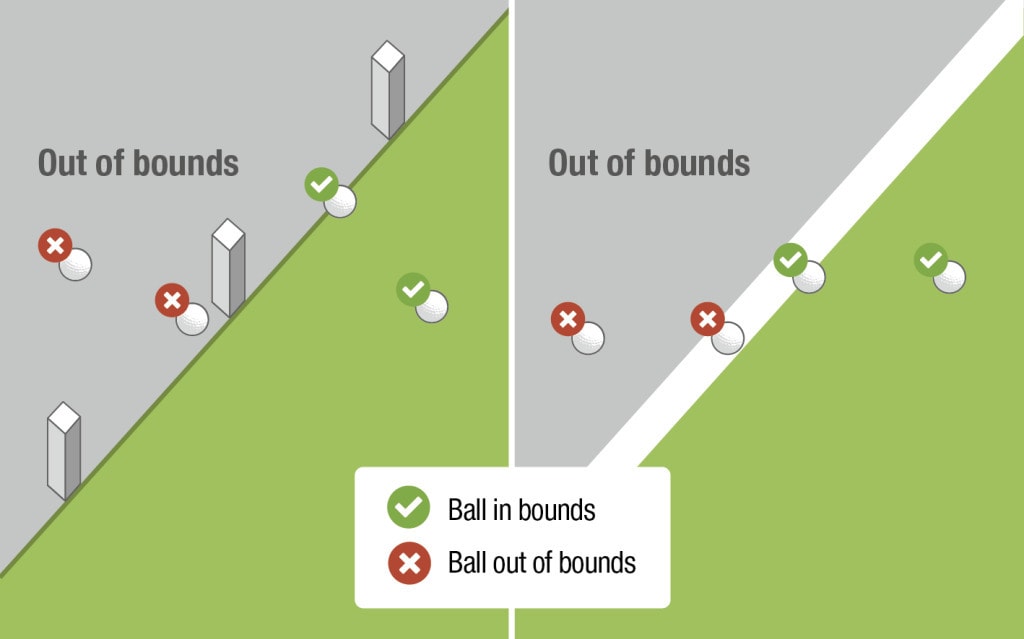
Out of bounds is clearly defined on a golf course using white stakes or white painted lines. These markings show the boundary between the playable area and land that’s considered off-limits.
- White stakes: Most common O.B. markers, spaced along the edge of the course
- White lines: Sometimes painted on the ground to connect or replace stakes
- Fences, walls, or roads: Can also serve as boundary markers if specified in the local rules
A ball is considered out of bounds when any part of it lies completely beyond the boundary line. If part of the ball is still on or above the course side of the line, it’s still in bounds.
Important: Stakes marking out of bounds are not movable and do not count as part of the course.
Out of Bounds Rules – Rule 18 Explained
The official Rules of Golf (Rule 18) cover what to do when your ball is out of bounds or lost. Here’s what you need to know:
Rule 18.1: Relief at Any Time
At any point, you’re allowed to take stroke-and-distance relief by replaying your shot from the previous spot with one penalty stroke. Once a new ball is put into play, the original ball is no longer in play, even if it’s later found.
Rule 18.2: Ball Lost or Out of Bounds
- A ball is lost if not found within 3 minutes of starting your search.
- A ball is out of bounds if all of it lies beyond the boundary line (see diagram 18.2a below).
- In both cases, you must take stroke-and-distance relief — replaying from the previous spot with a 1-stroke penalty.
- There is no drop zone or lateral relief for an O.B. shot.
Important: Stakes or painted lines marking out of bounds are considered outside the course.

Rule 18.3: Playing a Provisional Ball
To save time, you may hit a provisional ball if you believe your original ball might be lost or O.B.
- You must declare it as a “provisional” before playing it.
- You can play it multiple times, as long as you haven’t passed where your original ball might be.
- The provisional ball becomes your ball in play if:
- Your original is confirmed lost or O.B.
- You play the provisional from a spot closer to the hole than the original would be

Strategy: How to Avoid Hitting Out of Bounds
Know where O.B. is, aim away from trouble, use safer clubs, trust your shot shape, avoid over-swinging, and play a provisional ball when needed, these strategies will help you stay in play and avoid costly penalties.
Know where O.B. is located
Identify white stakes or lines before each shot so you don’t get caught off guard.
Play away from trouble
Favor the safe side of the hole, even if it means a longer second shot.
Club down for control
Use a 3-wood, hybrid, or long iron if your driver tends to miss wildly.
Use a consistent shot shape
Shape your shot away from the O.B. line. If you fade, aim left; if you draw, aim right.
Don’t chase distance near boundaries
Focus on control, not power, when the O.B. line is nearby.
Play a provisional ball if unsure
If you think your ball may be out of bounds, declare and hit a provisional to save time and avoid walking back.
Stay smart, not stubborn, playing safe doesn’t just protect your score, it builds confidence.
Common Mistakes Near Out of Bounds
Over-swinging, aiming too close to the line, ignoring your natural shot shape, and failing to hit a provisional ball, these mistakes often lead to unnecessary penalties and frustration:
Aiming too close to the O.B. line
Tempting tighter angles can backfire quickly. Give yourself margin for error.
Over-swinging for extra distance
Trying to “crush” a drive near O.B. often leads to wild hooks or slices.
Ignoring your natural shot shape
Fading the ball toward a right-side O.B. or drawing toward the left boundary is a risky move unless you fully control it.
Not playing a provisional ball
Walking forward and realizing your ball is lost or O.B., then having to go back, wastes time and breaks momentum.
Not knowing where O.B. starts
Misjudging the line or misunderstanding local rules can turn a borderline shot into a penalty.
Avoiding these common errors can save you strokes and keep your round on track.
Think before you swing!
FAQs About Out of Bounds
What happens if my ball lands on the O.B. line?
If any part of your ball is touching or overhanging the course side of the line, it is still in bounds. The entire ball must be beyond the line to be out.
Can I stand out of bounds to hit a shot?
Yes. Your position doesn’t matter, only the location of the ball does. You can legally stand outside the boundary to play a ball that’s still in bounds.
Are white stakes movable?
No. White stakes are fixed boundary objects and must not be moved to make a stroke easier.
Can I drop a ball near where it went out?
No. Out of bounds requires stroke-and-distance relief only. You must return to the spot of your previous shot and add a one-stroke penalty. However, some courses may offer a local rule (E-5) that allows a drop with added penalty for pace of play.
What’s the difference between out of bounds and a penalty area?
- Out of bounds = white stakes/lines, stroke-and-distance only, no drop allowed.
- Penalty areas = red/yellow stakes, may allow lateral drops and different relief options.
Get instant access to the PDF version of this article with additional resources and insights.