
TL;DR
Stroke (medal) play counts every shot; lowest total wins. Standard in pro, amateur and handicap golf; rewards consistency, punishes big errors.
Key Takeaways
- Medal play = stroke play – same format, different name.
- Every stroke counts, including penalties.
- Lowest total score wins over 18+ holes.
- Used in pro events like The Masters and PGA Tour.
- Rewards consistency, not just winning individual holes.
What is Medal Play in Golf?
Medal play in golf is a scoring format where the player with the lowest total number of strokes wins.
Also known as stroke play, this format is the most common in competitive golf. Here’s how it works:
- Every stroke counts from the first tee shot to the final putt.
- The total number of strokes over 18 holes (or more) is added up.
- The lowest score wins, regardless of how holes were played individually.
- It’s used in almost all professional tournaments (e.g., PGA Tour, The Masters, U.S. Open).
- In multi-round events, scores from each round are combined for a total tournament score.
- Penalties (e.g., for lost balls or rule infractions) add strokes to the total.

This format rewards consistency, focus, and error avoidance across the entire round or event.
Stroke Play vs Medal Play: Is There a Difference?
There is no difference between stroke play and medal play, they are two names for the same scoring format.
- Stroke play is the modern, widely used term, especially in North America.
- Medal play is the traditional British term, still used in some club competitions.
- Both formats count every stroke a player takes during the round.
- The goal in either is the same: finish with the lowest total score.
- Rules, scoring, and strategies are identical – only the terminology differs.
So whether a tournament calls it medal play or stroke play, the gameplay remains exactly the same.

How Stroke Play Works
In stroke play, every stroke a golfer takes is counted, and the player with the lowest total score wins.
Here’s how stroke play works:
- Each player plays their own ball from tee to hole on every hole.
- All strokes are counted, including penalty strokes.
- After the round, players add up their total number of strokes across all holes (usually 18 or more).
- The player with the lowest total score is the winner.
- In tournaments with multiple rounds (e.g., 72-hole events), scores are combined for a final total.
- Every mistake matters, a single bad hole can impact your entire result.

Example:
A golfer plays four rounds and scores: 72, 71, 70, and 74.
Total strokes = 72 + 71 + 70 + 74 = 287.
If this is the lowest total among all players, they win the tournament.
This format rewards consistent play and penalizes large errors, making it a true test of overall skill.
Summary of Rule 3.3 – Stroke Play (USGA & R&A)
1. Winner Determination
The player with the lowest total strokes over all rounds wins.
2. Scorecard Requirements
After each hole, the marker must record your gross score.
At the end of the round:
- Marker certifies each hole score.
- Player checks all scores, ensures marker certification, and then signs and returns the card to the Committee.
- Once submitted, the scorecard cannot be changed.
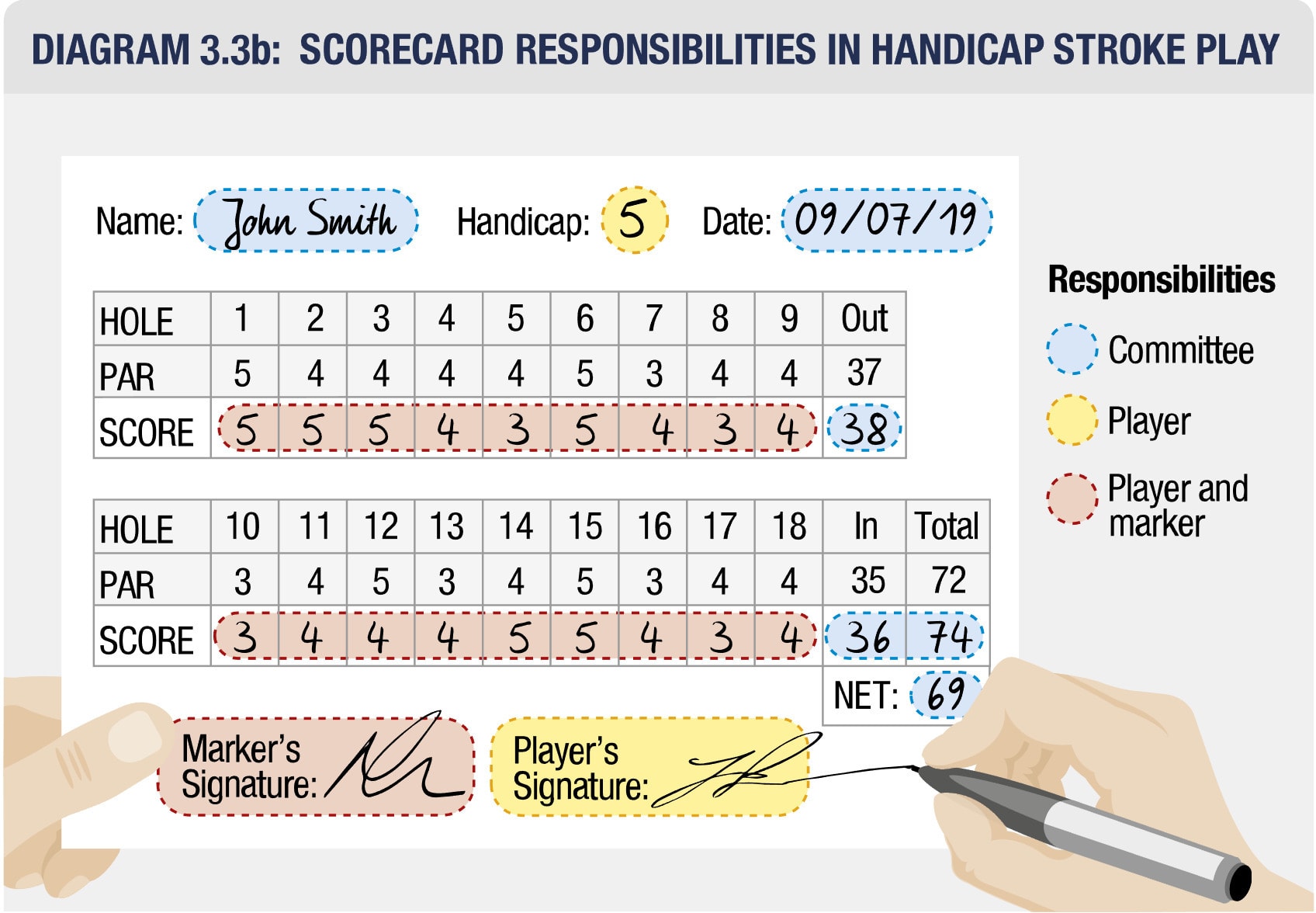
3. Disqualification Rules (DQ)
You are disqualified if:
- You return a score lower than you actually made on any hole.
- You fail to return a score for a hole.
- You do not follow scorecard procedures, such as missing a required signature.
If you return a higher score than what you actually made, the higher score stands (no penalty).
4. Handicap Competitions (Net Stroke Play)
You must ensure your correct handicap is shown on the scorecard.
Too high or missing handicap = disqualification from the handicap portion.
Too low handicap = no penalty, net score is calculated using the lower handicap.
You can read the full Rule 3.3 on stroke play at the official USGA website: https://www.usga.org/content/usga/home-page/rules/rules-2019/players-edition/rule-3.html
When and Where Medal Play is Used
Medal play is used in professional tours, major championships, amateur tournaments, and handicap scoring rounds.

In professional tours, stroke play is the standard format on the PGA Tour, LPGA Tour, European Tour, and Korn Ferry Tour, where players compete over multiple rounds and the lowest total score wins.
In major championships, all four men’s majors: The Masters, U.S. Open, The Open Championship, and PGA Championship, use stroke play to determine the champion based on cumulative scores.
In amateur tournaments, medal play is common in club championships, national and regional qualifiers, and junior competitions, where consistent scoring is key to ranking and advancement.
In handicap scoring rounds, recreational golfers use stroke play to post official scores for handicap calculation, since every stroke is recorded and reflects overall performance.
Medal Play vs Match Play
Medal play and match play differ in scoring method, objective, competition style, pressure, event usage, and how play continues.
| Aspect | Medal Play (Stroke Play) | Match Play |
|---|---|---|
| Scoring | Total number of strokes over the entire round(s) | Number of individual holes won |
| Objective | Have the lowest total score after all holes | Win more holes than your opponent |
| Competition | Compete against the full field | Compete directly against one player or team |
| Pressure | Mistakes impact the entire scorecard | Mistakes affect only the current hole |
| Used in | PGA Tour events, major championships, most amateur tournaments | Ryder Cup, Presidents Cup, USGA Amateur, friendly matches |
| Play continues | All holes are played (or cut after certain rounds in tournaments) | Ends when a player leads by more holes than remain |
Key difference: Medal play rewards consistency over the entire course, while match play focuses on winning one hole at a time, often allowing for more aggressive or strategic risk-taking.

Strategy Tips for Medal Play
Key strategies for medal play include smart shot selection, course management, mistake recovery, score awareness, rules knowledge, purposeful putting, and mental focus.

Here are strategy tips for each:
- Smart shot selection: Play percentage golf, choose the shot with the highest chance of success, even if it’s not the most aggressive option.
- Course management: Plan your way around the course based on your strengths, avoiding hazards and aiming for safe landing zones.
- Mistake recovery: Don’t chase a bad hole. Accept the score, reset mentally, and avoid compounding errors on the next shot.
- Score awareness: Know your score relative to par, but avoid obsessing over it during the round. Stay focused on the current shot.
- Rules knowledge: Be familiar with stroke play rules, including how to handle penalties, drops, and relief situations correctly.
- Purposeful putting: Prioritize solid lag putting to avoid three-putts, and treat every short putt with focus and routine.
- Mental focus: Maintain concentration through all 18 holes, using pre-shot routines and deep breathing to manage nerves and fatigue.
These tips help golfers stay steady and competitive throughout a medal play round.
Pros and Cons of Medal Play
The pros of medal play include fairness, consistency, simplicity, and broad usage, while the cons involve score vulnerability, mental pressure, slower pace, and less head-to-head drama.

Pros of Medal Play
- Fairness: Every stroke is counted, making the format objective and transparent.
- Consistency rewarded: Players who manage the course steadily are more likely to succeed.
- Simplicity: Easy-to-understand scoring for players, officials, and viewers.
- Broad usage: Standard in nearly all professional and amateur competitions.
Cons of Medal Play
- Score vulnerability: A single bad hole can ruin an entire round.
- Mental pressure: Requires sustained focus and resilience over many holes.
- Slower pace: Full rounds for large fields can lead to longer play times.
- Less head-to-head excitement: Lacks the direct, hole-by-hole competition of match play.
Medal play tests overall performance and endurance, rewarding those who can manage both their game and emotions across the full round.
Common Mistakes in Stroke Play
Common mistakes in stroke play include miscounting strokes, rule violations, poor course management, mental lapses, and ignoring the scorecard process.

Here’s a breakdown of each:
- Miscounting strokes: Forgetting to include penalty strokes or losing track of shots can lead to disqualification or incorrect scores.
- Rule violations: Not knowing or misapplying rules—such as improper drops, grounding the club in a hazard, or hitting a wrong ball—can result in penalty strokes.
- Poor course management: Taking unnecessary risks, attacking tough pins, or not playing to your strengths often leads to high scores.
- Mental lapses: Getting frustrated after a bad hole, rushing decisions, or losing focus late in the round can lead to compounding mistakes.
- Ignoring the scorecard process: Failing to check, sign, or submit your scorecard properly can result in penalties or disqualification, especially in tournaments.
Avoiding these mistakes helps protect your score and ensures your round stays valid and competitive.
FAQs: Medal Play (Stroke Play)
Is medal play the same as stroke play?
Yes. Medal play and stroke play are different names for the same format. “Medal play” is a traditional term, while “stroke play” is more commonly used today.
What happens if I have one bad hole in medal play?
Every stroke counts, so a bad hole can hurt your total score. However, you can still recover with consistent play on the remaining holes.
How is the winner determined in stroke play?
The player with the lowest total number of strokes after all holes (usually 18 or more) is the winner.
Can stroke play be used for team formats?
Yes. Team stroke play formats exist, such as best ball or combined score formats in amateur and pro events.
Do penalties count in stroke play?
Absolutely. All penalties (e.g., for lost balls, out of bounds, or rule breaches) are added to your total score.
Is stroke play used in professional golf?
Yes. Nearly all professional tournaments, including the PGA Tour, The Masters, and U.S. Open, use stroke play.
Can a player be disqualified in stroke play?
Yes. Common reasons include signing an incorrect scorecard, failing to include penalty strokes, or breaking a rule without correcting it.
Get instant access to the PDF version of this article with additional resources and insights.