
TL;DR – Marker / Attester in One Line
A marker/attester is a fellow competitor who records your hole-by-hole score, verifies its accuracy, and signs your scorecard to make it official under Rule 3.3b.
Key Takeaways
- A marker records each hole score during a round, usually in stroke play.
- An attester signs the scorecard to confirm it’s accurate and complete.
- The same person usually serves as both marker and attester.
- Both the player and attester must sign the scorecard, missing either = disqualification.
- Governed by Rule 3.3b of the Rules of Golf.
- Crucial for fair play, official results, and self-officiated competition.
What Is a Marker / Attester in Golf?
A marker/attester is a fellow golfer who is responsible for recording and verifying your score during a round of golf, especially in stroke play tournaments. While the marker writes down your scores hole by hole, the attester confirms the accuracy by signing the completed scorecard. In most cases, the same person performs both roles.
This process is a key part of the game’s integrity and self-regulation, governed by Rule 3.3b of the Rules of Golf. After the round:
- The marker signs the scorecard as attester.
- The player also signs to confirm their own scores.
- The Committee then accepts the scorecard to make the result official.

The marker/attester system ensures every player’s performance is tracked fairly and honestly, without referees following every group.
What Does a Marker Do?
A marker records another player’s scores, notes penalties, ensures scorecard clarity, signs the card, and confirms rules-related details when needed. These tasks are crucial for maintaining accurate and fair play in stroke play formats.
- Record hole-by-hole scores for the assigned player immediately after each hole.
- Confirm any penalties with the player and note them properly.
- Clarify unclear rulings with the player or request help from a Rules official.
- Ensure legibility and completeness of the scorecard before submitting it.
- Sign the scorecard at the end of the round, becoming the attester.

The marker doesn’t total the final score (the Committee handles that), but they play a critical role in making sure every stroke and penalty is recorded correctly.
What Does an Attester Do?
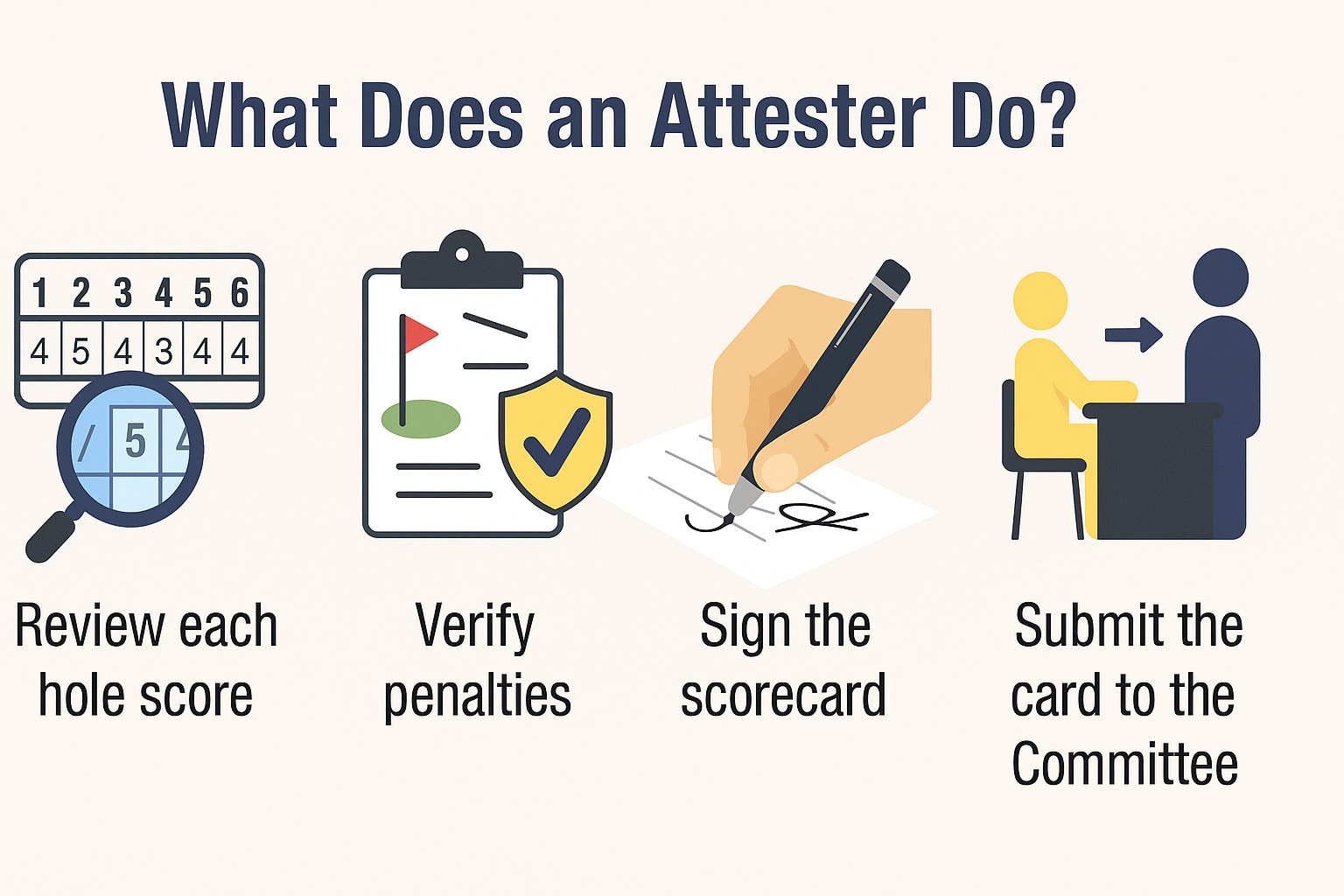
An attester reviews each hole score, verifies penalties, signs the scorecard, ensures no changes are made after signing, and submits the card to the Committee. These actions confirm the score’s validity under the Rules of Golf:
- Reviewing each hole score to confirm they match what was played
- Verifying any penalties are correctly included
- Signing the scorecard to officially attest to its accuracy
- Ensuring no changes are made after both signatures
- Submitting the card (or returning it to the Committee, depending on event rules)
Together with the player’s signature, the attester’s confirmation makes the scorecard official and eligible for competition results.
Who Can Be a Marker or Attester?
A marker or attester must be a fellow competitor, appointed or approved by the Committee, knowledgeable about the Rules of Golf, attentive, honest, and not scoring their own round. These conditions ensure scorekeeping is fair and reliable.
- Usually a fellow player in the same group during stroke play
- Must be appointed or approved by the Committee in formal events
- Should understand scoring and penalty rules
- Needs to be attentive and honest when recording scores
- Cannot be the player marking their own scorecard
This structure helps maintain the integrity of the game and supports accurate score verification under Rule 3.3b.
Why Marker / Attester Roles Matter
Marker and attester roles matter because they ensure accurate scoring, promote honesty and integrity, prevent cheating or mistakes, validate tournament results, and support self-officiated play:
- Ensure accurate scoring for every hole
- Promote honesty and integrity, which are core to golf
- Prevent cheating or accidental mistakes in scorekeeping
- Validate tournament results through official signatures
- Support self-officiated play without the need for referees
These roles form the backbone of fair competition and uphold the trust-based nature of the game.
Rule References
Marker & Attester Responsibilities (Rule 3.3b)
The roles of marker and attester are defined in Rule 3.3b of the Rules of Golf, which outlines the duties and consequences related to scorecards in stroke play:
Rule 3.3b(1): Marker’s Responsibilities
- Confirm each hole score with the player immediately after the hole.
- Record gross scores (including penalty strokes) on the scorecard.
- Certify the scorecard by signing it at the end of the round.
- If multiple markers are used, each must certify only the holes they witnessed—unless one marker saw the full round.
- A marker may refuse to sign if they believe a score is incorrect. In that case, the Committee will make a ruling.
- A marker who knowingly certifies a false score is disqualified under Rule 1.2a (serious misconduct).
Rule 3.3b(2): Player’s Responsibilities
- Review the scorecard for correct scores and penalties.
- Ensure the marker signs the scorecard.
- Certify the scores by signing the card.
- Return the scorecard promptly to the Committee without making further changes.
- A player who fails any of these steps is disqualified, unless the failure was beyond their control (e.g. marker leaves with the card).

Rule 1.2 and Marker Responsibility
While Rule 3.3b explains the duties of a marker and attester, Rule 1.2 defines how all golfers, including markers, are expected to conduct themselves on the course.
Rule 1.2a: Standards of Conduct
Markers are expected to:
- Act with integrity by recording scores honestly and applying penalties correctly
- Show consideration by cooperating with the player and not interfering with play
- Uphold the spirit of the game by being fair, truthful, and respectful
A marker who knowingly certifies an incorrect score or helps a player avoid a penalty may be considered guilty of serious misconduct. Under Rule 1.2a, this can lead to disqualification, even if the act wasn’t directly related to their own round.
Rule 1.2b: Code of Conduct
In some competitions, the Committee may adopt a Code of Conduct with specific standards and penalties (such as stroke penalties or warnings). Markers should follow any additional expectations laid out by the Committee.
Common Mistakes to Avoid
Common mistakes include forgetting to sign the scorecard, recording incorrect hole scores, omitting penalties, making changes after signing, and submitting the card late or to the wrong place.
- Forgetting to sign the scorecard (by either player or marker): Disqualification
- Recording incorrect hole scores: Lower score = DQ, higher score = stands
- Omitting penalty strokes that should have been included
- Making changes after both signatures: Scorecard becomes invalid
- Submitting the card late or to the wrong location: May lead to DQ depending on event rules

Avoiding these errors is crucial for ensuring your score is accepted and your round is valid under Rule 3.3b.
Remember: A wrong lower score = DQ, a wrong higher score stands.
FAQs About Marker / Attester
Can I be my own marker or attester?
No. You are not allowed to mark or attest your own score. A fellow competitor or someone appointed by the Committee must do it.
What happens if the marker makes a mistake on my scorecard?
If you notice the mistake before submitting the card, you can correct it. Once both parties sign and the card is submitted, errors may lead to penalties or disqualification depending on the type of mistake.
Do both the player and marker need to sign the scorecard?
Yes. Both signatures are required to make the scorecard official. Missing either signature results in disqualification.
Does the marker have to total the player’s score?
No. Under the Rules of Golf, the Committee is responsible for totaling the scores. The marker only needs to ensure each hole score is correct.
Can a marker also be a fellow competitor in match play?
The marker/attester role is specific to stroke play. In match play, players are responsible for keeping track of the match themselves, no official marker is needed.
Get instant access to the PDF version of this article with additional resources and insights.