
TL;DR
A hazard in golf was the old rules term for bunkers and water hazards, but since 2019 the official terms are penalty areas and bunkers.
Key Takeaways
- Hazard = outdated rules term (removed in 2019).
- Replaced by penalty areas (red/yellow) and bunkers.
- Penalty = 1 stroke for relief, with red vs yellow options.
- Bunkers have stricter relief rules, sometimes 2 strokes.
- Golfers still casually say “hazard,” but rules don’t.
What Is a Hazard in Golf?
A hazard in golf is an older rules term that referred to bunkers and water hazards on the course. These were areas specifically meant to challenge players and often carried penalty strokes if your ball ended up in them.
Under the Rules of Golf before 2019, hazards included sand bunkers, water hazards marked with yellow stakes, and lateral hazards marked with red stakes. Since the 2019 rules change, the term hazard is no longer official. Instead, bunkers are treated separately, and water hazards are now called penalty areas. Even so, many golfers still casually use the word “hazard” when talking about tough spots on the course.

Summary: Hazard was the old rules term for bunkers and water hazards, now replaced by penalty areas and bunkers.
Types of Hazards (Old Rules)
The main types of hazards in golf under the old rules were bunkers, water hazards, and lateral water hazards. Each type was marked differently and carried its own set of relief options and penalties.
- Bunkers: Sand-filled areas designed to test control and precision.
- Water Hazards (Yellow Stakes): Lakes, ponds, rivers, or ditches that required stroke-and-distance or back-on-the-line relief with a one-stroke penalty.
- Lateral Water Hazards (Red Stakes): Water features running alongside the fairway, where players could take lateral relief two club-lengths from where the ball last crossed the margin.
These categories made up the full definition of a hazard before the 2019 Rules of Golf, after which bunkers and penalty areas were redefined separately.
Rules Change: 2019 Onward
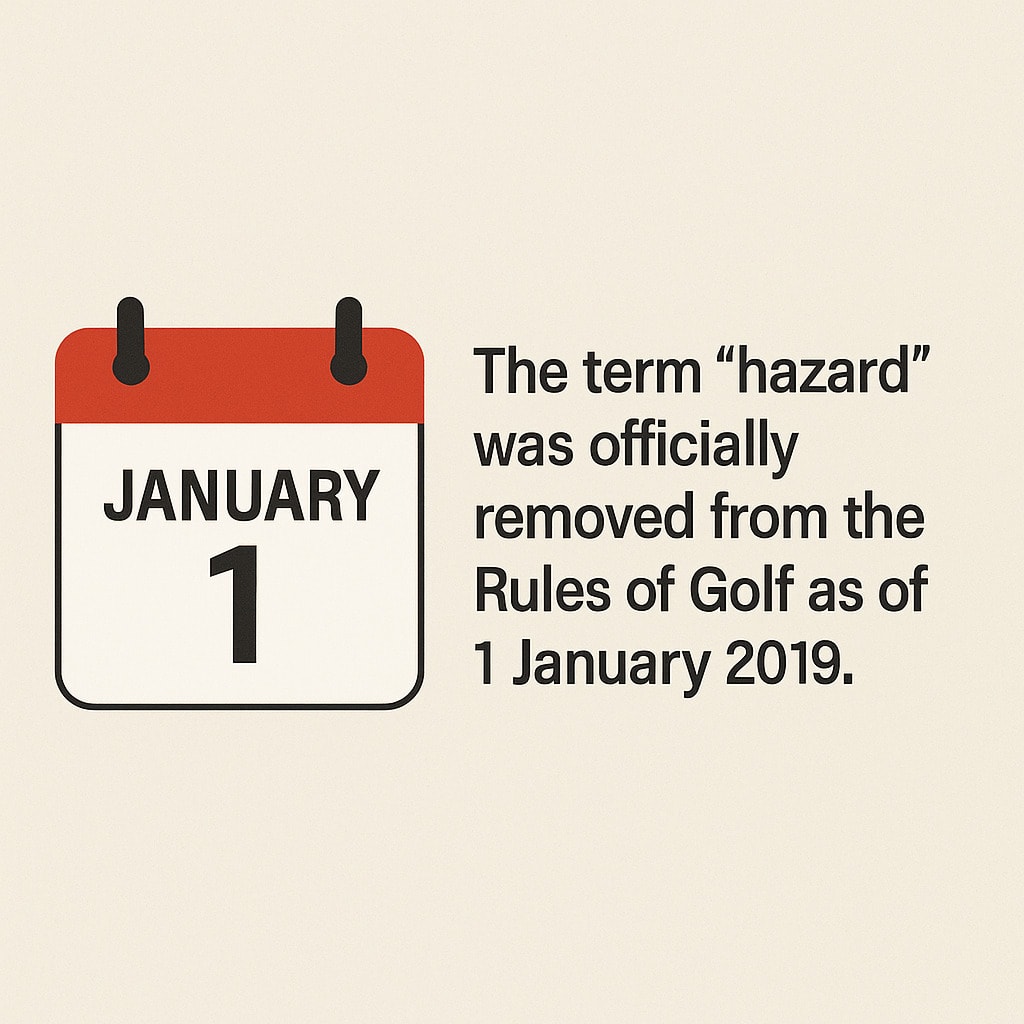
The term “hazard” was officially removed from the Rules of Golf as of 1 January 2019.
Under the updated rules, what used to be grouped together as “hazards”, namely bunkers and water hazards, are now completely separate categories. Bunkers remain defined as they have always been: sandy areas designed as obstacles. Meanwhile, former water hazards have been replaced with the broader and more flexible category of penalty areas, which can include water as well as other features a committee chooses to mark.
Penalty areas can now encompass creative course elements beyond water, such as lava rock, desert terrain, jungle-like rough, and more, as determined by the course committee. These areas must be marked either red (similar to old lateral water hazards, offering lateral relief options) or yellow (similar to old water hazards, with relief options based on stroke-and-distance or back-on-the-line).
This terminology change was part of a broader Rules Modernization project aimed at simplifying and clarifying the language of the Rules, making them easier to learn and apply.
Key Highlights of the Change
- Hazard (umbrella term) eliminated, now split into bunkers and penalty areas.
- Penalty Areas introduced as a flexible category that includes water and other challenging areas a committee may designate.
- Red vs. Yellow marking remains to indicate the type of relief options, just as it did before.
- These changes became official on January 1, 2019, as part of a comprehensive effort to modernize and simplify the Rules of Golf.
Penalties & Relief Options
A hazard in golf always brought penalty strokes and limited relief options, and since 2019 these are now handled separately under the rules for bunkers and penalty areas.

Relief from Penalty Areas (Red or Yellow)
- Stroke-and-distance: Play again from where the previous shot was made (1-stroke penalty).
- Back-on-the-line: Drop a ball behind the penalty area, keeping the point of entry between you and the hole (1-stroke penalty).
- Lateral relief (Red only): Drop within two club-lengths of where the ball last crossed the margin, no closer to the hole (1-stroke penalty).
- Play it as it lies: No penalty if you choose to play the ball directly from the penalty area.
Relief from Bunkers
- Play it as it lies: Always an option, no penalty.
- Unplayable ball inside bunker: Three choices with 1-stroke penalty:
- Stroke-and-distance (go back and replay).
- Back-on-the-line inside the bunker.
- Drop within two club-lengths in the bunker, not nearer the hole.
- Special option: Back-on-the-line outside the bunker, but this carries a 2-stroke penalty (Rule 19.3b).
Key Notes
- Relief rules mirror the old system for yellow/red hazards but with simplified language.
- Bunkers keep stricter relief rules than penalty areas to preserve their challenge.
- Committees must clearly mark penalty areas red or yellow so golfers know their options.
Strategy & Mindset Around Hazards
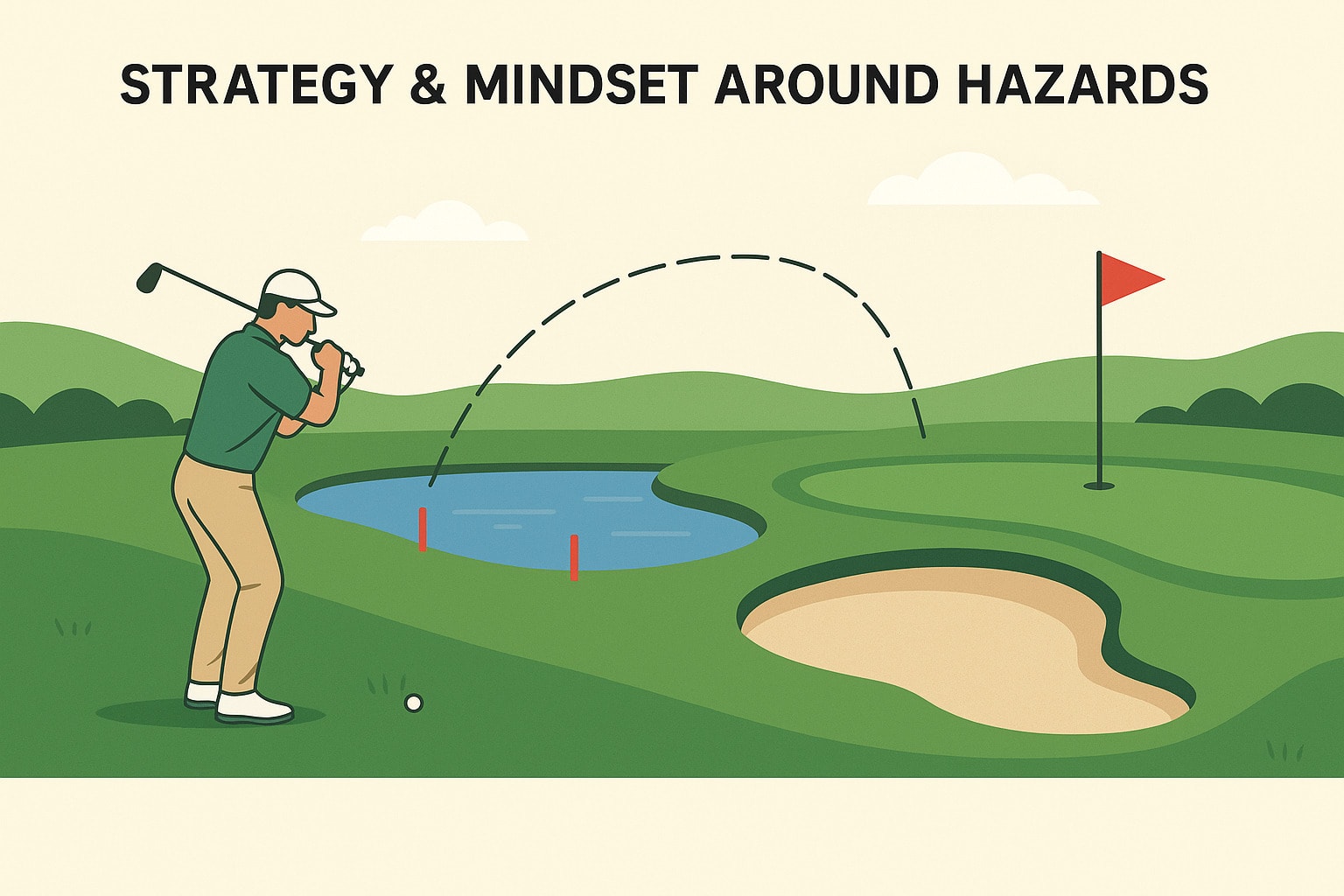
A hazard in golf forces players to weigh risk versus reward, making smart decisions just as important as swing execution.
Golf course architects design bunkers, ponds, creeks, and other penalty areas to challenge accuracy and strategy. When facing these hazards, golfers must decide between:
- Playing safe: Laying up short of a water hazard, aiming away from a bunker, or choosing a higher-lofted club to clear danger.
- Taking on the risk: Trying to carry a pond, attack a tight pin near a bunker, or thread a narrow fairway between penalty areas.
- Course management: Knowing when a bogey is acceptable, when par is realistic, and when to gamble for birdie.
Good players see hazards not just as punishment, but as a test of discipline. Even though the official rules now say penalty areas and bunkers instead of hazards, the mindset is the same: hazards shape your decisions and separate smart golf from reckless golf.
Common Mistakes Golfers Make
The most common mistakes golfers make with hazards are still saying “hazard,” mixing up red vs. yellow stakes, not knowing bunker relief rules, failing to identify the entry point, and playing casual drops.
Still saying “hazard”: Many golfers don’t realize the term was removed in 2019. The correct terms are now penalty area (red or yellow) and bunker.
Mixing up red vs. yellow stakes: Forgetting that red (lateral) areas allow two-club-length relief, while yellow areas require stroke-and-distance or back-on-the-line only.
Not knowing bunker relief rules: Some assume they can drop outside a bunker with one stroke, when in fact that option costs two strokes (Rule 19.3b).
Failing to identify the entry point: Relief must be based on where the ball last crossed the edge of the penalty area, not where it ended up.
Playing casual “mulligan drops”: Dropping a ball at a convenient spot instead of following the official procedure, which can lead to additional penalties in competition.
Avoiding these mistakes keeps your game within the rules and saves unnecessary penalty strokes.
FAQs
Is “hazard” still an official term in golf?
No, the term hazard was removed from the Rules of Golf in 2019. Today, those areas are called penalty areas (red or yellow) and bunkers, though many golfers still use “hazard” informally.
What is the difference between a bunker and a hazard?
A bunker is a sandy area specifically designed as a challenge, while a hazard was the old umbrella term that included both bunkers and water hazards. Under modern rules, bunkers are separate from penalty areas.
What is the penalty for hitting into a hazard?
The standard penalty is one stroke for relief options in a penalty area (red or yellow) and one stroke inside a bunker for unplayable relief. Dropping outside a bunker carries a two-stroke penalty.
What do red and yellow stakes mean in golf?
Red stakes mark a lateral penalty area, where you can take a two-club-length drop. Yellow stakes mark a standard penalty area, where relief is limited to stroke-and-distance or back-on-the-line options.
Why did golf change the term from hazard to penalty area?
The change was part of the 2019 Rules Modernization to simplify language, make rulings clearer, and give committees more flexibility in marking challenging areas beyond just water.
Get instant access to the PDF version of this article with additional resources and insights.