
TL;DR – Handicap Index in One Line
A Handicap Index is the average of your 8 best score differentials (out of 20), giving every golfer a portable, course-neutral measure of potential ability.
Key Takeaways
- Handicap Index shows your potential, not average score
- Based on your best 8 of 20 recent rounds
- Adjusted for course difficulty using Slope Rating
- Enables fair competition between players
- Converts into a Course Handicap for each course
- Updates daily with new scores
What Is a Handicap Index in Golf?
A Handicap Index is a numerical measure of a golfer’s potential playing ability, used to ensure fair competition among players of different skill levels. It is calculated based on your best scores from recent rounds, not your average, and is standardized globally through the World Handicap System (WHS).
This index allows golfers to compete equitably by adjusting their scores according to the difficulty of the course they’re playing. A lower Handicap Index means a more skilled player, while a higher index reflects a less experienced or inconsistent golfer.
The Handicap Index reflects your potential skill level based on past performance, while a gross score simply records the total strokes taken in a single round.
How Is Handicap Index Calculated?
A Handicap Index is calculated by averaging the best 8 Score Differentials from your most recent 20 rounds, using a formula that accounts for course difficulty. This system ensures your index reflects your potential ability, not just your average score.
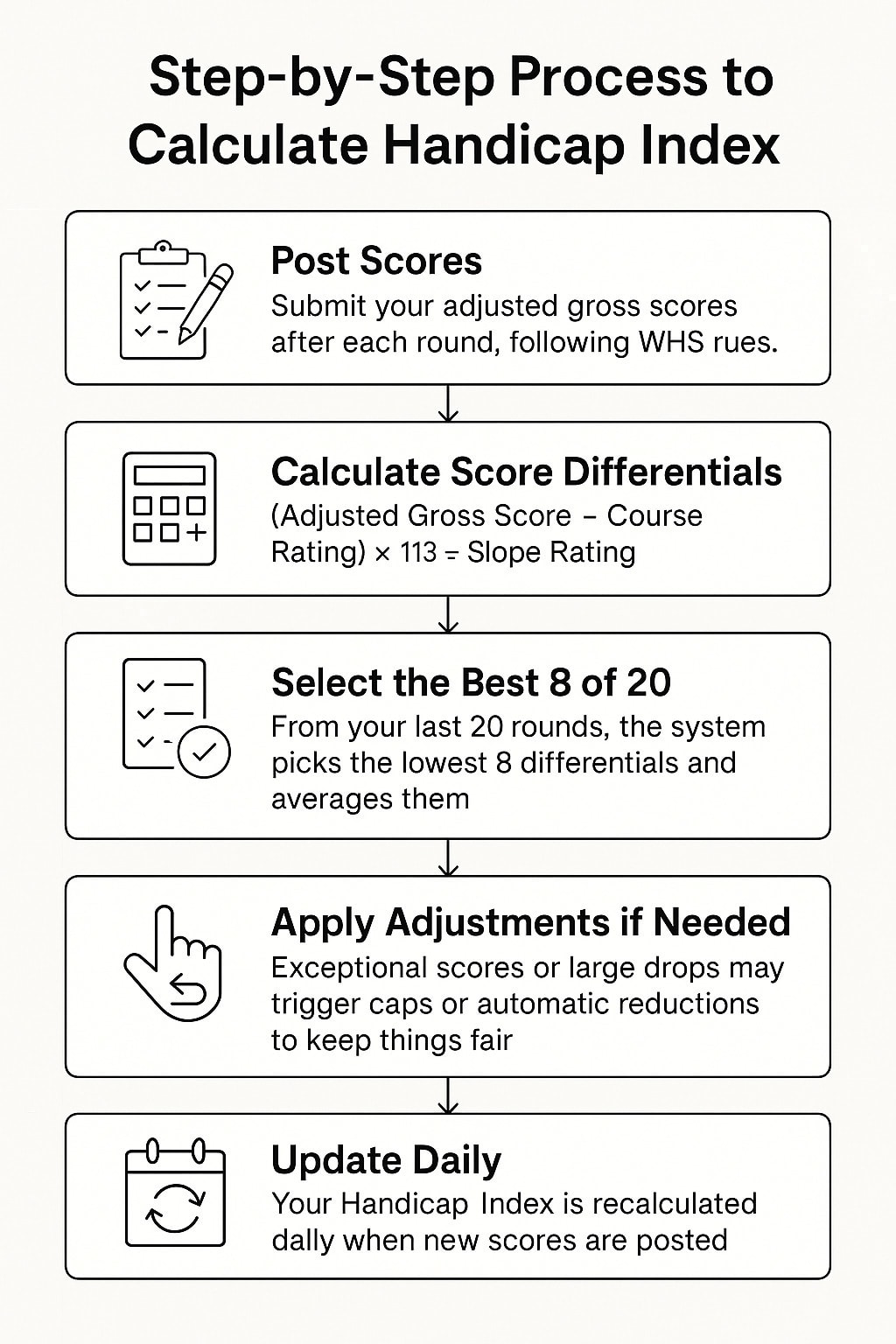
Step-by-step process to calculate Handicap Index
Post Scores: Submit your adjusted gross scores after each round, following WHS rules.
Calculate Score Differentials: For each round, compute a Score Differential using:
(Adjusted Gross Score – Course Rating) × 113 ÷ Slope Rating
Select the Best 8 of 20: From your last 20 rounds, the system picks the lowest 8 differentials and averages them.
Apply Adjustments if Needed: Exceptional scores or large drops may trigger caps or automatic reductions to keep things fair.
Update Daily: Your Handicap Index is recalculated daily when new scores are posted.
Example: Calculating a Handicap Index
Let’s say a golfer has just completed 20 rounds and posted the following Score Differentials (from each round):
14.2, 13.5, 15.0, 12.8, 16.4, 14.9, 13.0, 13.8, 15.6, 14.5, 12.4, 14.1, 15.2, 13.2, 14.0, 13.9, 16.0, 15.3, 13.6, 14.8
Step 1: Select the 8 lowest differentials
The 8 best (lowest) differentials are: 12.4, 12.8, 13.0, 13.2, 13.5, 13.6, 13.8, 13.9
Step 2: Calculate the average of these 8
Average = (12.4+12.8+13.0+13.2+13.5+13.6+13.8+13.9)÷8 = 13.275
Step 3: Round to one decimal place
Handicap Index = 13.3
This means the golfer’s Handicap Index is 13.3, which can then be converted into a Course Handicap depending on where they play.
Handicap Index vs Course Handicap
A Handicap Index is your universal measure of golfing ability, while a Course Handicap is the adjusted number of strokes you’re allowed on a specific course and set of tees.
Both are part of the World Handicap System (WHS), but they serve different purposes.
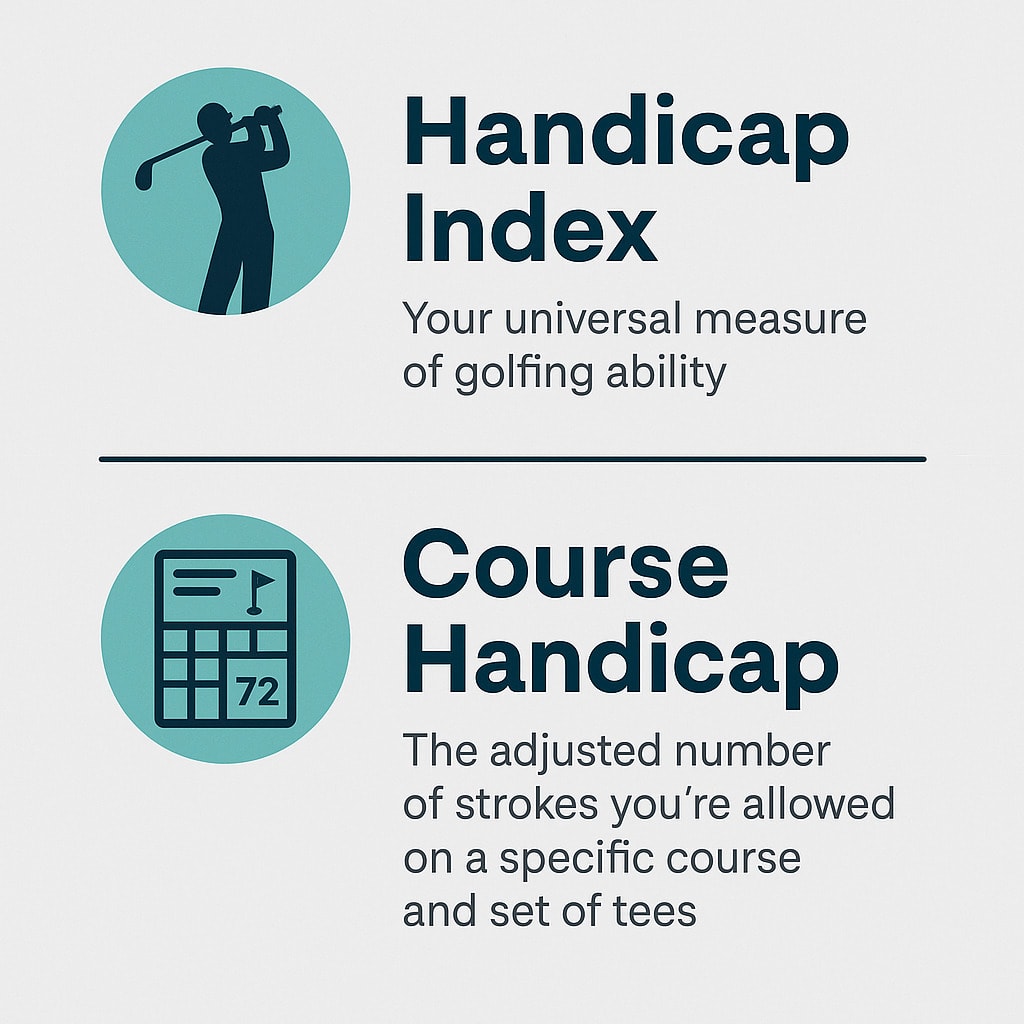
Let’s break down the difference between Handicap Index and Course Handicap: what they are, where they apply, how they’re used, how they’re calculated, and where each one shows up.
| Feature | Handicap Index | Course Handicap |
|---|---|---|
| What it is | Standardized measure of potential ability | Strokes you’re allowed on a specific course |
| Where it applies | Valid worldwide and course-neutral | Specific to the course and tee you’re playing |
| How it’s used | Basis for calculating Course Handicap | Used to determine your net score in competitions |
| Calculation | Best 8 of last 20 Score Differentials | Based on Handicap Index, Course Rating, and Slope |
| Displayed on | GHIN profile, club systems | Scorecard or app for each round |
Course Handicap Formula:
Course Handicap = Handicap Index × Slope Rating ÷ 113 + (Course Rating – Par)
This formula adjusts for the difficulty of the course and the tee box being played, making competition fair across different setups.

Why Handicap Index Matters
The Handicap Index matters because it enables fair competition, helps track improvement, supports net scoring formats, is required in official events, stays portable across courses, and reflects your true playing potential:
Enables fair competition
It levels the playing field so that high- and low-handicap players can compete equitably in tournaments or casual rounds.
Tracks your improvement
As you post better scores, your Handicap Index drops, giving you a clear, measurable sign of progress.
Used in net scoring formats
Essential for formats like Stableford, match play, or net stroke play, where handicaps are used to adjust scores.
Required for official play
Many amateur events, club tournaments, and leagues require a valid Handicap Index to participate.
Portable across courses
Thanks to the World Handicap System, your index works at any course worldwide, adjusting automatically via Course Handicap conversion
Reflects potential, not just results
Unlike a gross average, the index highlights what you’re capable of, rewarding your best rounds, not penalizing occasional bad ones.
How to Get and Maintain a Handicap Index
To get and maintain a Handicap Index, you need to join a recognized service, post valid scores, follow WHS rules, submit at least 3 rounds, keep posting regularly, and play with integrity.
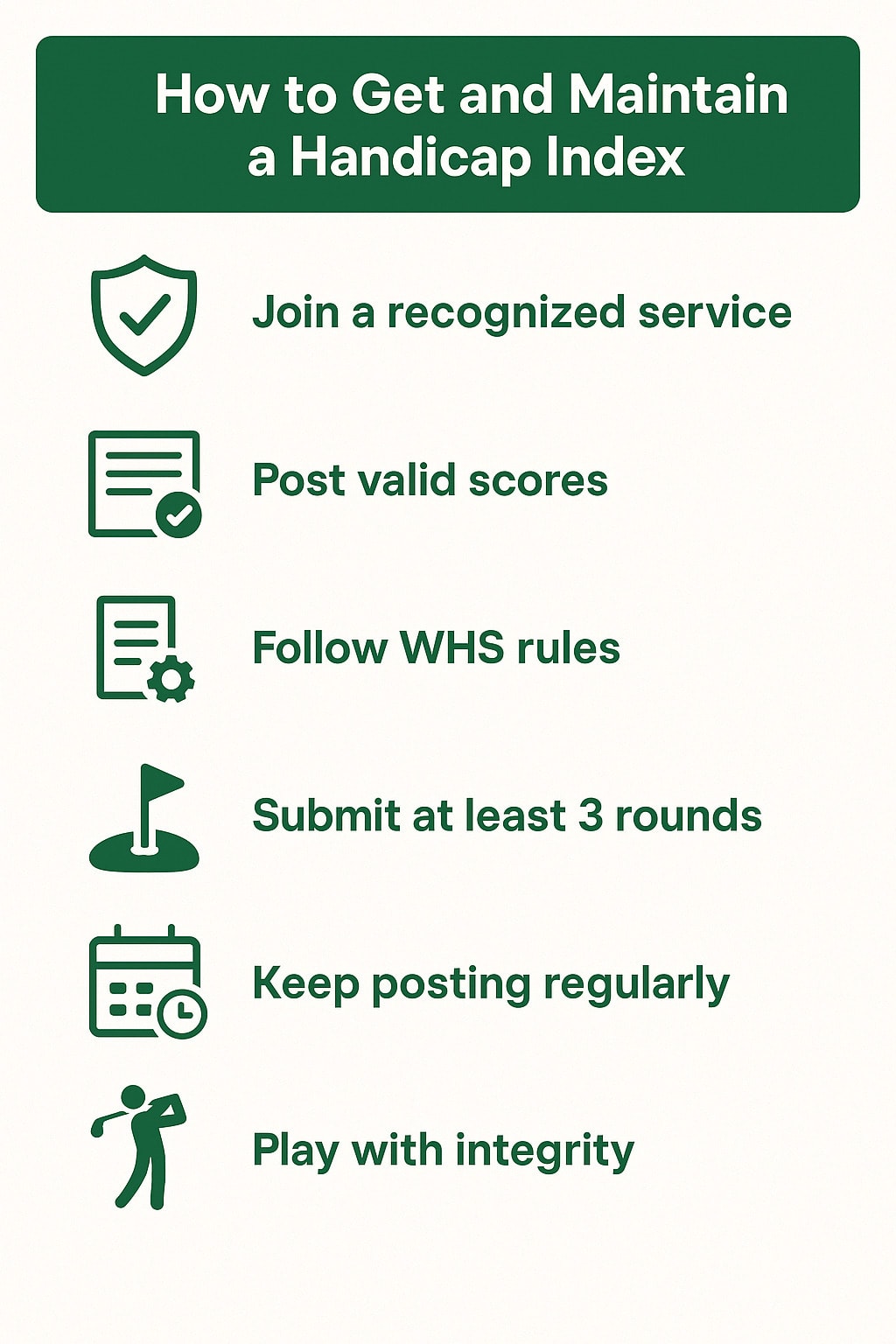
1. Join a recognized service or club
Sign up with a golf club, regional association, or official app like GHIN, which is authorized to issue and manage Handicap Indexes.
2. Play and post valid scores
Play 9 or 18-hole rounds under the Rules of Golf and post your adjusted gross scores after each round.
3. Follow WHS score posting rules
Apply the Net Double Bogey adjustment for max hole scores, and be aware of acceptable playing conditions (weather, course setup, etc.).
4. Post at least 3 full rounds to get started
Your initial Handicap Index is calculated after 3 18-hole rounds (or equivalent 9-hole scores) are posted.
5. Keep posting to stay current
Your index updates daily when new scores are added. The system uses your best 8 of the last 20 differentials to keep it accurate.
6. Play with integrity
The Handicap Index relies on honesty. Always post scores that reflect your true performance, no sandbagging or vanity handicaps.
Common Mistakes and Misunderstandings
Many golfers struggle with their Handicap Index because they confuse it with average score, only post good rounds, ignore WHS adjustments, misunderstand how often it updates, and think it stays fixed.
1. Confusing Handicap Index with scoring average
Your Handicap Index reflects your potential, not your average. It’s based on your best rounds, not all of them.
2. Only posting good rounds
Some players avoid posting bad rounds, which skews the system and gives an inaccurate index. You should post all eligible rounds.
3. Ignoring WHS adjustments
Failing to apply Net Double Bogey limits or not adjusting scores for unusual conditions can lead to errors in your index.
4. Assuming it updates weekly or monthly
The WHS updates Handicap Indexes daily, not weekly. New scores may affect your index as soon as the next day.
5. Thinking the index never changes
Your Handicap Index is dynamic, it can go move or down as your recent scores change. It’s designed to reflect your current potential.
Handicap Index FAQs
1. How often does a Handicap Index update?
It updates daily under the World Handicap System (usually overnight) whenever you post a new score.
2. What’s the maximum Handicap Index allowed?
54.0 for both men and women under WHS. Some tournaments may set a lower max for competition purposes.
3. Do 9-hole scores count?
Yes. Two 9-hole rounds are combined into one 18-hole score differential, and they count toward your Handicap Index.
4. Can I have more than one Handicap Index?
No. Under the WHS, each golfer should maintain only one Handicap Index, even if they play in multiple countries or clubs.
Get instant access to the PDF version of this article with additional resources and insights.