
TL;DR
A flop shot is a high, soft shot with minimal roll, used to stop the ball quickly near the hole.
Key Takeaways
- Flop = high launch + soft landing with minimal roll.
- Played with a lob wedge (60°–64°).
- Best for short-sided lies and clearing obstacles near the green.
- Setup: open stance, open face, ball forward.
- High risk: requires precise contact to avoid thin or fat shots.
- Practice drills improve confidence and consistency.
What Is a Flop Shot in Golf?
A flop shot in golf is a high, soft shot played with an open-faced lob wedge to stop the ball quickly with minimal roll.
It’s designed to help you get the ball up quickly and stop it fast, often when you have little green to work with. Here’s what makes a flop shot unique: club choice, ball flight, typical use, setup, and risk factor.
- Club choice: Usually played with a lob wedge (58°–64°).
- Ball flight: Very high trajectory, soft landing.
- Typical use: Clearing a bunker, mound, or rough close to the green.
- Setup: Open stance, open clubface, ball forward.
- Risk factor: Requires precise contact. mistakes can lead to thin or chunked shots.

When to Use a Flop Shot
Use a flop shot when you need the ball to fly high, land softly, and stop quickly, especially in tricky short-game situations. Common scenarios include over an obstacle near the green, short-sided lies, elevated greens, tight lies to tucked pins, and downhill-to-green shots.
- Over an obstacle near the green: such as a bunker, mound, or thick rough.
- Short-sided lies: when the pin is close and you have very little green to work with.
- Elevated greens: where you need extra height to stop the ball fast.
- Tight lies to tucked pins: requiring precision to avoid rolling past the hole.
- Downhill-to-green shots: where roll-out would cause the ball to run too far.
These situations all demand a high, soft shot with minimal roll, making the flop shot the safest way to stop the ball close to the hole. Avoid the flop shot if you have plenty of green, a poor lie, or no obstacle to carry

Clubs for a Flop Shot
The lob wedge (60°–64°) is the go-to club for a flop shot because its high loft launches the ball steeply, helping it land softly with minimal roll.
Two key factors also influence how easy it is to play:
- Bounce angle: Lower bounce (4°–8°) is better from tight lies, while higher bounce (10°–14°) helps prevent digging in soft turf or sand.
- Sole grind: A grind with heel and toe relief lets you open the clubface more without raising the leading edge, making it easier to slide the club under the ball.
Choosing the right lob wedge with suitable bounce and grind makes flop shots easier, cleaner, and more consistent.
How to Hit a Flop Shot
Hitting a flop shot requires the right club, an open setup, and a committed swing that slides the club under the ball. Follow these 6 steps:
- Choose the right club: Use a lob wedge (60°–64°) with suitable bounce and grind for the lie.
- Open the clubface: Rotate the face open before gripping to add loft and expose the bounce.
- Set up open: Position your stance open to the target and aim the clubface at the landing spot.
- Ball forward: Play the ball slightly forward in your stance to encourage higher launch.
- Swing along your stance: Hinge wrists early, accelerate through impact, and let the club glide under the ball.
- High finish: Follow through fully to maintain loft and avoid decelerating.
Mastering these six steps will give you the confidence to pull off flop shots under pressure and save strokes around the green.
Common Mistakes and How to Avoid Them
The most common flop shot mistakes are decelerating at impact, not opening the clubface enough, poor lie selection, ball too far back, and overusing the flop.
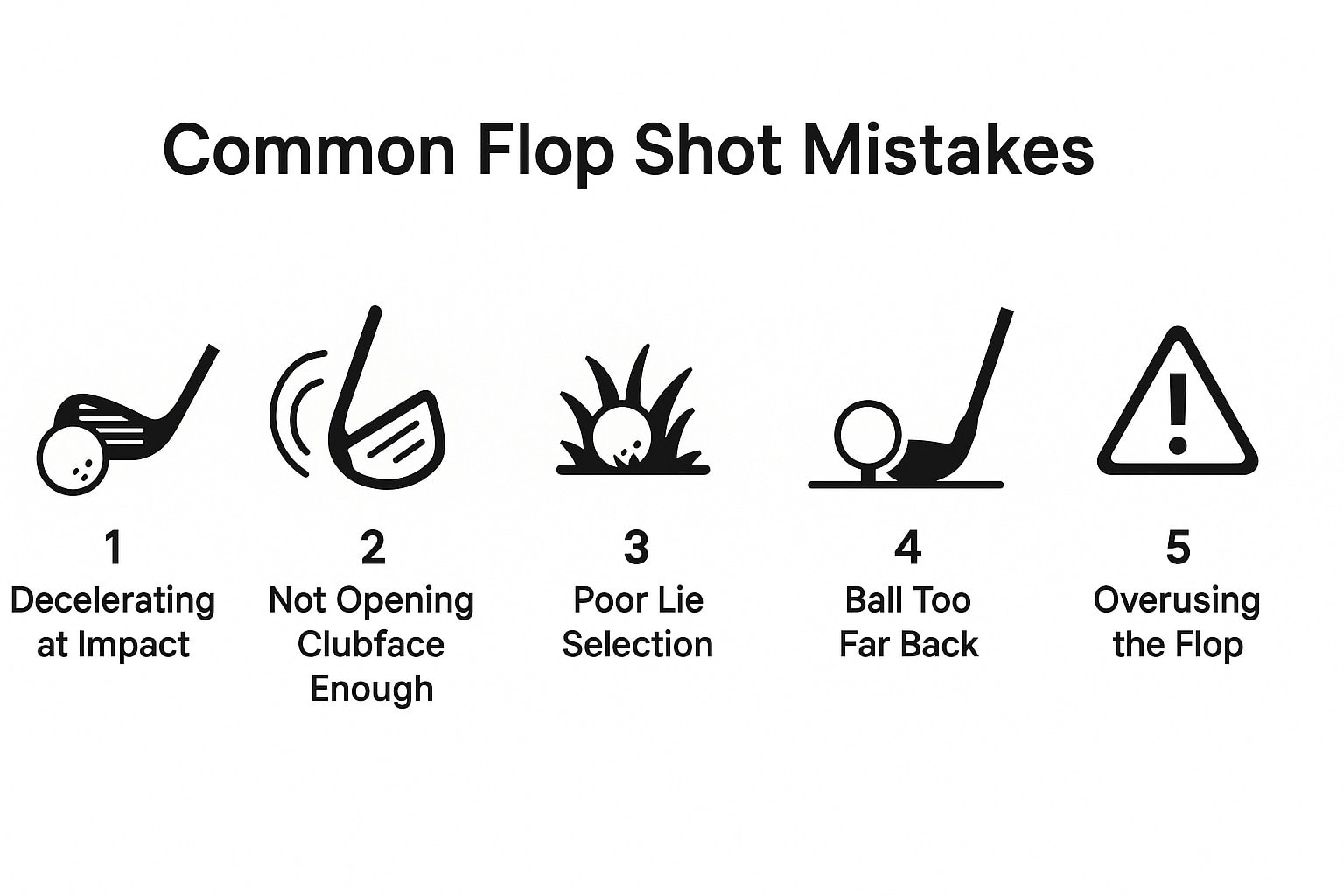
Decelerating at impact
This happens when you slow the club down before hitting the ball, often from fear of going too far. It causes fat shots (hitting the ground first) or thin shots (skimming the ball).
Fix it: Trust your swing, keep accelerating through impact, and make a full follow-through.
Not opening the clubface enough
A square or slightly open face won’t create enough loft for a proper flop.
Fix it: Rotate the clubface open before gripping, and keep it open through the swing to use the bounce effectively.
Poor lie selection
Trying a flop from deep rough, bare turf, or soggy ground makes it hard to slide the club under the ball.
Fix it: Choose a clean, tight lie or light rough for higher success; pick a safer shot if the lie is bad.
Ball too far back
Placing the ball back in your stance lowers launch and increases the chance of digging.
Fix it: Position the ball forward, just inside your lead heel, to promote height and soft landing.
Overusing the flop
Some golfers use the flop even when a safer chip or pitch would do. This adds unnecessary risk.
Fix it: Save the flop for situations where you must carry an obstacle and stop the ball quickly.
Practice Drills for a Flop Shot
The best flop shot practice drills are towel landing drill, elevated target drill, variable loft drill, and soft-landing zone drill. These drills improve your feel, height control, and confidence so you can hit flop shots more consistently under pressure
- Towel Landing Drill: Place a towel a few yards away on the green and aim to land the ball on it. This trains height control and soft landings.
- Elevated Target Drill: Hit flop shots to a raised surface (like an upslope or practice green tier) to practice clearing obstacles and stopping the ball quickly.
- Variable Loft Drill: Use the same wedge but slightly adjust how open the clubface is. This teaches you how face angle changes launch height.
- Soft-Landing Zone Drill: Mark a small target area on the green with tees and try to land the ball inside it with minimal roll.

Practice these drills regularly to make the flop shot a reliable scoring tool instead of a last-resort gamble.
Flop Shot vs. Pitch Shot
The main differences between a flop shot and a pitch shot are height, roll, difficulty, club choice, and purpose.
| Feature | Flop Shot | Pitch Shot |
|---|---|---|
| Height | Very high trajectory | Medium-high trajectory |
| Roll | Minimal to none | Some roll after landing |
| Difficulty | High risk, needs precise contact | Moderate difficulty |
| Club choice | Lob wedge (60°–64°) | Wedge or short iron (46°–56°) |
| Purpose | Stop ball quickly over an obstacle | Controlled distance with some release |
Flop shot: Clears obstacles, stops quickly.
Pitch shot: Controlled distance, some roll.
Summary: A flop shot is the go-to when you must clear something and stop the ball immediately, while a pitch shot is better for medium-height shots with some roll for control.
FAQs – Flop Shot in Golf
1. Is a flop shot hard to hit?
Yes, it’s one of the hardest short-game shots because it requires precise contact, the right setup, and full commitment to the swing.
2. What club should I use for a flop shot?
A lob wedge (60°–64°) is preferred, though some golfers use a sand wedge (56°) if they need slightly less height.
3. Can I hit a flop shot from any lie?
No, it works best from a clean, tight lie or light rough. Heavy rough, wet turf, or bare lies make it much harder.
4. When should I avoid a flop shot?
Avoid it when you have plenty of green to work with, the lie is poor, or a simpler chip or pitch can do the job.
5. How do I practice flop shots safely?
Use short swings at first, practice landing on specific targets, and focus on making clean contact before adding full height.
Get instant access to the PDF version of this article with additional resources and insights.