
TL;DR
A bunker is a specially prepared sand area that challenges recovery shots and demands different technique than grass lies.
Key Takeaways
- Bunker = prepared sand area on the course, distinct from penalty areas.
- Main types: greenside, fairway, pot bunkers, and waste areas.
- Governed by special rules, no grounding club right behind/in front of the ball before a stroke.
- Shot technique differs from grass lies; often strike sand first for control.
- Practice bunker play to improve recovery, save strokes, and build confidence.
What Is a Bunker in Golf?
A bunker is a specially prepared area of sand placed to test recovery skills, commonly near greens (greenside) or along fairways (fairway). Unlike grass, sand reduces roll and requires striking sand first for control. Bunkers are not penalty areas and have their own rules.

Types of Bunkers
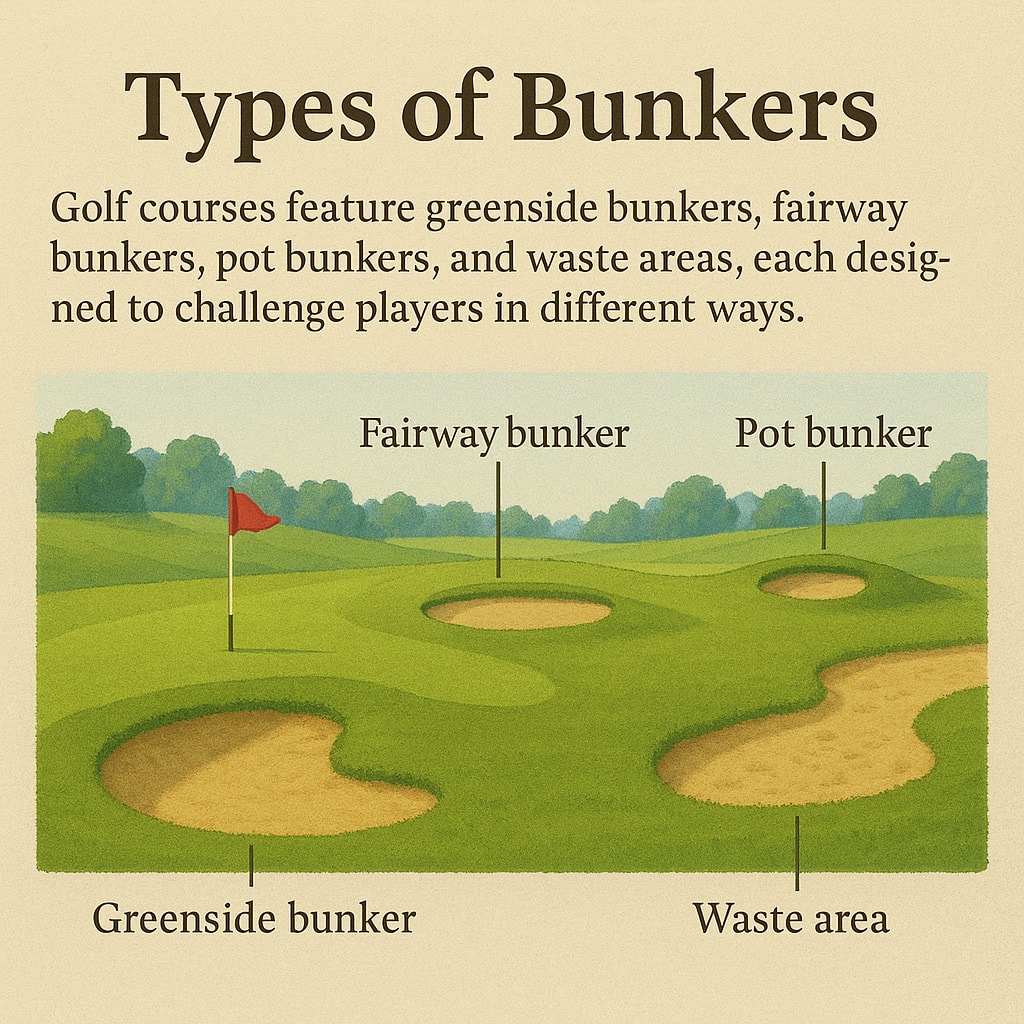
Golf courses feature greenside bunkers, fairway bunkers, pot bunkers, and waste areas, each designed to challenge players in different ways.
Greenside Bunkers: Located close to the putting green, they require a high, soft shot to stop the ball quickly.
Fairway Bunkers: Found along the fairway, these catch errant tee shots or approaches and demand clean ball contact for distance.
Pot Bunkers: Small, deep bunkers with steep faces, common on links courses, making escape shots more difficult.
Waste Areas: Large sandy areas that look like bunkers but are not treated as hazards under the Rules of Golf, allowing grounding of the club.
Bunker Rules in Golf
Under the Rules of Golf, bunkers are considered special hazards with specific restrictions and allowances:
- No grounding the club in the sand directly behind or in front of the ball before the stroke.
- Loose impediments (like leaves or stones) can be removed without penalty, as allowed in the 2019 rules update.
- You may remove loose impediments and touch sand incidentally, but you must not touch sand right in front of/behind the ball or make a practice swing that touches sand.
- Practice swings must avoid touching the sand.
If the ball is unplayable in a bunker, you have these relief options:
- Stroke-and-distance: go back to where you played last (1 penalty stroke).
- Lateral relief in bunker: drop within two club-lengths, no nearer the hole (1 penalty stroke).
- Back-on-the-line in bunker: drop on a line from the hole through the ball’s position (1 penalty stroke).
- Back-on-the-line outside bunker: drop outside the bunker (2 penalty strokes).
How to Play From a Bunker
Playing from a bunker involves three key approaches: greenside bunker shots, fairway bunker shots, and general bunker techniques. Each requiring different setup, swing, and contact adjustments to escape successfully.
Greenside Bunker Shot
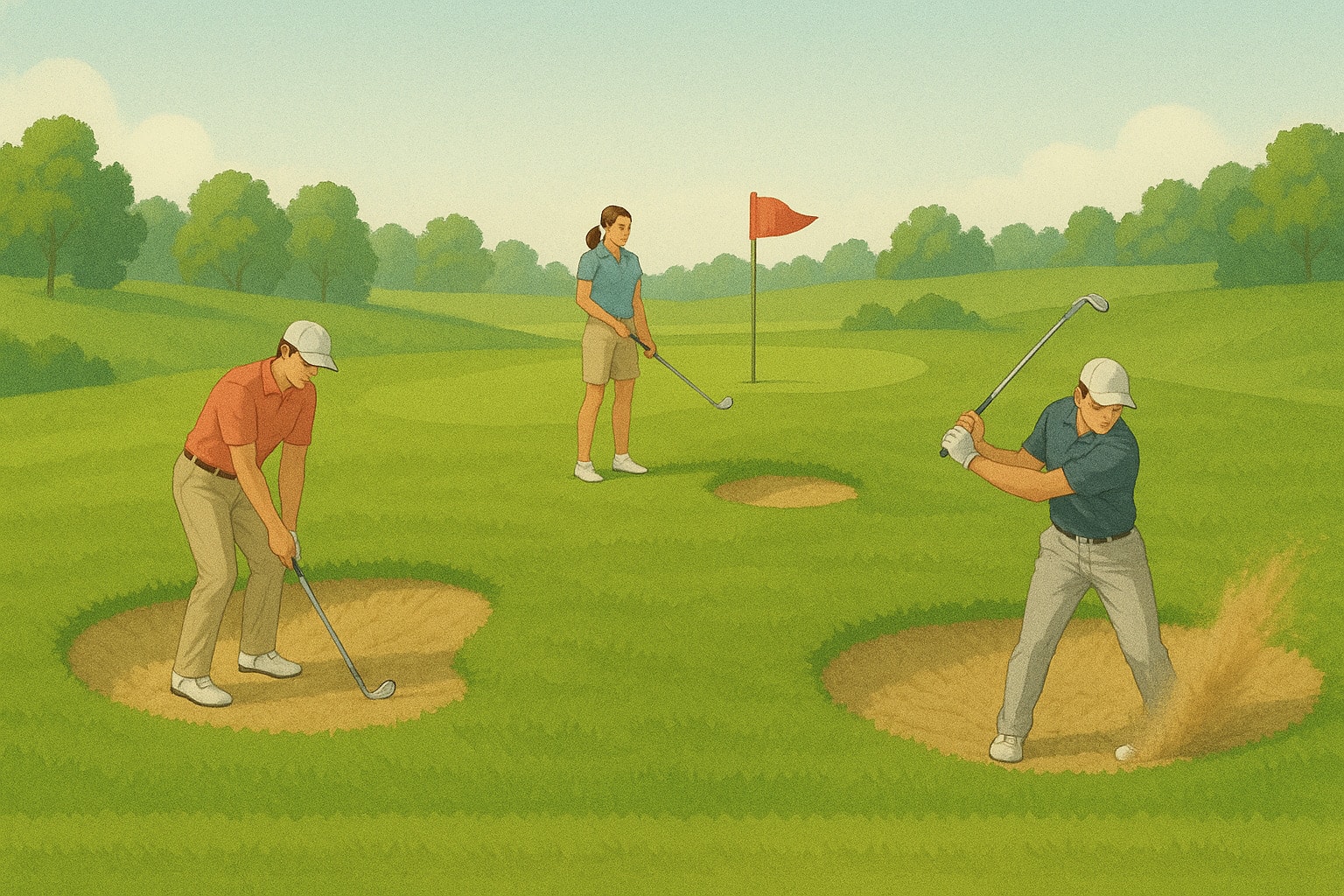
- Open stance & clubface to add loft and use the bounce.
- Aim to hit the sand 1-2 inches behind the ball, letting the sand lift it out.
- Maintain steady lower body and a full follow-through for height and control.
Fairway Bunker Shot
- Square stance & clubface for straighter ball flight.
- Focus on clean ball-first contact to preserve distance.
- Club choice: Pick enough loft to clear the lip (when in doubt, choose more loft). If the lip is low and you’re going for distance, take one extra club, choke down, and make a controlled swing.
- Make a controlled, smooth swing to ensure accuracy over power.
General Bunker Tips
- Keep your weight slightly forward to control entry point.
- Use a wider stance for stability in the sand.
- Adjust swing length and speed based on distance to target.
Common Mistakes in Bunker Play
Golfers often make bunker mistakes such as scooping the ball, misjudging sand contact, choosing the wrong club, poor weight distribution, weak commitment, closed clubface, and bad stance or ball position.
- Scooping the ball: Focus on hitting sand first, letting the bounce lift the ball.
- Too much or too little sand contact: Practice entry point drills to control depth.
- Wrong club choice: Match loft and bounce to the bunker’s lip height.
- Poor weight distribution: Keep weight slightly forward for consistent strike.
- Lack of commitment: Maintain swing speed through the shot.
- Closed clubface: Keep the face open (greenside) for loft and spin.
- Incorrect stance or ball position: Adjust setup for greenside vs. fairway bunkers.
Mastering bunker play takes practice, but with the right setup, mindset, and swing, you can turn sand traps into scoring opportunities.

Tips to Improve Bunker Play
Improving bunker play comes down to practicing explosion shots, reading sand conditions, using the club’s bounce, controlling swing speed, and adjusting setup for different bunker types.
- Practice explosion shots: Focus on striking the sand, not the ball, for consistent loft.
- Read the bunker: Check sand depth and texture to adjust swing and club choice.
- Use the club’s bounce: Let the sole glide through sand to prevent digging.
- Control swing speed: Match speed to shot distance; don’t decelerate through impact.
- Adjust for bunker type: Open stance for greenside, square stance for fairway bunkers.
- Aim for a consistent entry point: Practice hitting the same spot behind the ball.
With regular practice and smart adjustments, bunker shots can become a strength rather than a struggle.
Bunker Etiquette
Bunker etiquette includes raking the sand, entering and exiting from the low side, avoiding others’ ball areas, placing the rake correctly, and keeping up pace of play.
Rake the bunker after play: Smooth out footprints and club marks so it’s fair for the next golfer.
Enter and exit from the low side: Avoid damaging high bunker lips or steep edges.
Avoid stepping near another player’s ball: Preserve the original lie until it’s their turn.
Leave the rake in the proper position: Follow course guidelines (usually outside the bunker).
Be mindful of pace: Prepare your shot in advance so play flows smoothly.
FAQs About Bunkers in Golf
What is a bunker in golf?
A bunker is a sand-filled hazard designed to challenge golfers and test recovery skills.
What are the main types of bunkers?
The main types are greenside bunkers, fairway bunkers, pot bunkers, and waste areas.
Can I ground my club in a bunker?
No, you can’t touch the sand with your club right before your stroke, except in certain incidental cases allowed by the Rules of Golf.
What’s the best club for bunker shots?
A sand wedge is most common, but fairway bunkers may require lower-loft clubs for distance.
How do I get out of a greenside bunker?
Open your stance and clubface, aim to hit the sand just behind the ball, and follow through.
Are waste areas the same as bunkers?
No, waste areas are sandy zones not considered hazards, so you can ground your club and take practice swings.
What’s the penalty for an unplayable ball in a bunker?
You can take relief within the bunker for one penalty stroke, or drop outside for two penalty strokes.
How can I improve my bunker play?
Practice explosion shots, control swing speed, and learn to read sand texture for better shot planning.
Get instant access to the PDF version of this article with additional resources and insights.