
TL;DR
Ball position is the foundation of a solid golf setup, get it right for each club, adjust for different shots, and you’ll strike the ball cleaner and more consistently.
Key Takeaways
- Ball position matters: it affects strike quality, direction, and trajectory.
- Drivers: ball just inside the lead heel for an upward strike.
- Fairway woods & hybrids: ball slightly forward of center to sweep it cleanly.
- Irons: ball just forward of center for long/mid, center for short.
- Wedges: ball center or slightly back for crisp, spin-heavy contact.
- Adjust for shots & lies: forward for high shots/uphill, back for low shots/downhill.
- Use simple checks (shirt logo, sternum, alignment sticks) for consistency.
- Avoid common mistakes: one position for all clubs, too far forward/back, or overcorrecting.
Ball position is one of the simplest setup fundamentals, but also one of the most overlooked. Where you place the ball in your stance directly impacts strike quality, shot shape, and consistency. Mastering it gives you a reliable foundation for every club in your bag.
Why Ball Position Matters
Ball position directly affects how the club meets the ball at impact, influencing strike quality, direction, and trajectory. Even with a solid swing, the wrong position can cause mis-hits:
- Too far back: leads to fat shots, low slices, or steep strikes.
- Too far forward: produces thin shots, topped balls, or hooks.
Correct ball position helps the clubface return square, controls the angle of attack, and ensures consistent contact. Drivers need the ball forward to catch it on the upswing, while irons and wedges perform best with the ball centered or slightly back to promote compression and control.
Standard Ball Position for Different Clubs
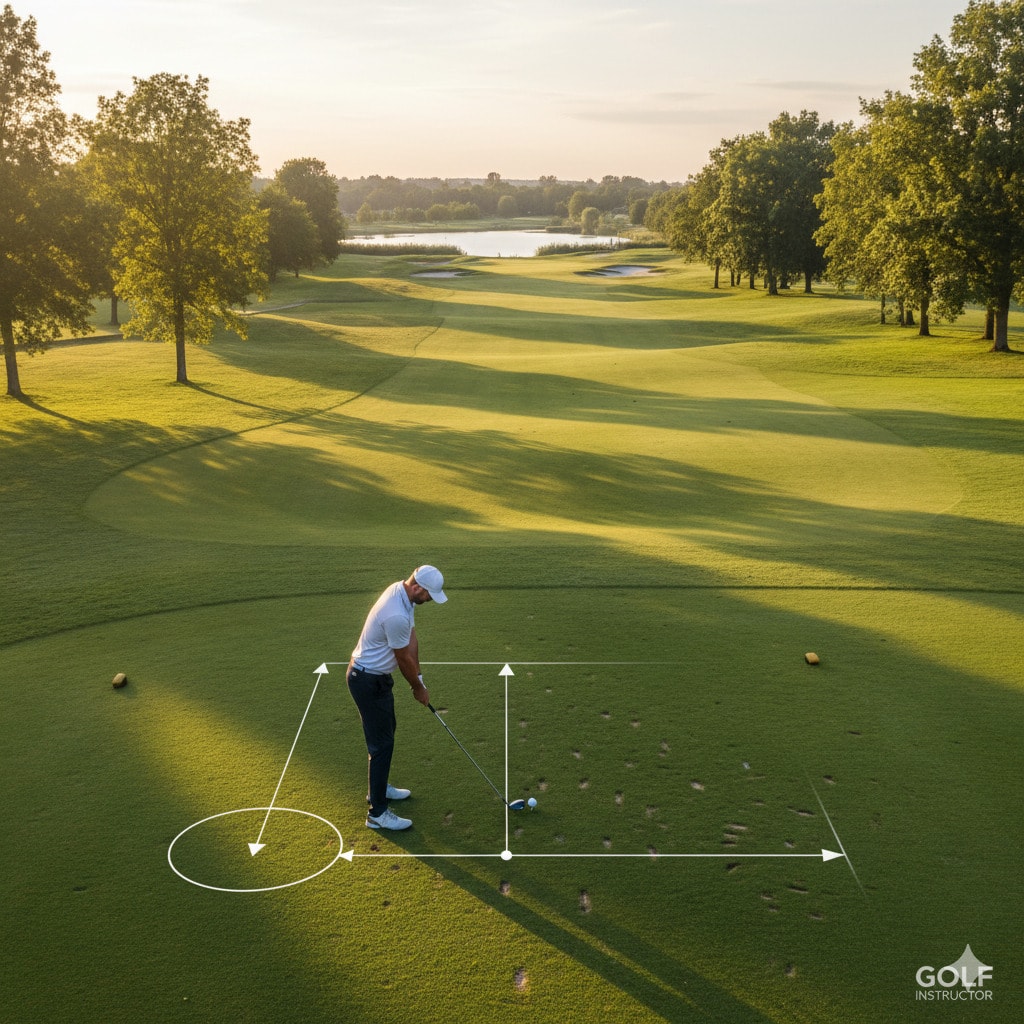
Ball position changes depending on the club you’re hitting: driver, fairway woods, hybrids, long irons, mid irons, short irons, and wedges, because each has different length, loft, and purpose.
- Driver: Just inside the lead heel for an upward strike and maximum distance.
- Fairway Woods / Hybrids: Slightly forward of center to sweep the ball cleanly.
- Long & Mid Irons: Just forward of middle for a controlled descending strike.
- Short Irons: Near the center for accuracy and consistency.
- Wedges: Center or slightly back to ensure ball-first contact and spin control.
Rule of thumb: Longer clubs = ball forward. Shorter clubs = ball more central or slightly back.
Driver
With the driver, the ball should be positioned just inside your lead heel. This forward position encourages an upward strike, which helps launch the ball higher with less spin for maximum distance. If the ball is too far back, you’ll likely hit down on it, creating unwanted backspin and losing distance.

Fairway Woods
For fairway woods, keep the ball slightly forward of center, but not as far forward as the driver. This allows you to sweep the ball off the turf cleanly without taking a deep divot. It promotes solid contact and keeps the trajectory strong but controlled.
Hybrids
Hybrids are designed to replace longer irons and are more forgiving, so the ball should also be slightly forward of center. This position balances distance and control, giving you the best chance at solid contact whether you’re hitting off the tee or from the fairway.
Long Irons (2–4 Iron)
Place the ball just forward of middle. With long irons, you want a slight descending strike to compress the ball while still launching it high enough to cover distance. Too far back, and you’ll dig in and lose height; too far forward, and you risk thin shots.
Mid Irons (5–7 Iron)
For mid irons, position the ball just forward of center. This encourages a controlled downward strike that compresses the ball and provides a balanced combination of distance and accuracy. It’s the “middle ground” of ball positions.
Short Irons (8–9 Iron)
With short irons, move the ball close to the center of your stance. This ensures a steeper descending strike for maximum control and consistent contact. Accuracy is the priority here, not raw distance.
Wedges
For wedges, the ball should be in the center or slightly back of your stance. This guarantees you hit the ball before the turf, creating the clean, crisp contact that produces spin and stopping power on the greens.
Adjustments Based on the Shot
Small tweaks in ball position can help shape shots and adapt to conditions such as hitting high shots, low/flighted shots, draws, fades, uphill lies, downhill lies, tight turf, and rough.
High Shots (slightly forward)
- Why: Moving the ball forward increases the launch angle and lets the clubface work with more loft.
- When to use: Clearing hazards, holding the green, or hitting into the wind with confidence.
Low/Flighted Shots (slightly back)
- Why: A back position steepens the angle of attack, keeping the ball flight down.
- When to use: Punch shots, windy conditions, or keeping the ball under tree branches.
Draw (a touch back)
- Why: A slightly back ball position helps the club come from the inside, encouraging a right-to-left shape.
- When to use: Adding distance, avoiding hazards on the right, or working with a dogleg left.
Fade (a touch forward)
- Why: Forward placement helps you keep the face a bit more open at impact, promoting a left-to-right shape.
- When to use: Controlling distance, holding greens, or playing around a dogleg right.
Uphill Lies (slightly forward)
- Why: Matches the slope so you don’t hit behind the ball.
- When to use: Anytime the slope tilts up toward your target — gives you cleaner contact and more height.
Downhill Lies (slightly back)
- Why: Prevents you from catching the ground early and helps you catch the ball first.
- When to use: On sloping fairways where the ball is below your feet toward the target.
Tight Turf (center or slightly back)
- Why: Ensures a crisp, ball-first strike without the risk of bouncing the club off the ground.
- When to use: On firm fairways, links-style courses, or thin lies.
Rough (forward with longer clubs, center with wedges)
- Why: Longer clubs need a forward position to help them glide through the grass, while wedges need to be centered to dig under and get the ball out cleanly.
- When to use: Anytime you’re in heavy grass and need reliable contact.
Mastering these small adjustments gives you the flexibility to handle different shots and lies with confidence. Next, let’s look at some practical ways to check your ball position so you can build consistency every time you set up
Practical Tips to Check Ball Position
- Lead-side markers: For irons, line the ball up with your shirt logo; for driver, just inside the lead heel.
- Sternum check: Align ball with shirt buttons, center for irons, forward for driver.
- Alignment sticks: Place two on the ground (target line and stance line) to confirm consistent position.
- Step-in routine: Start with feet together, step small with lead foot and larger with trail foot to find the right spot.
- Divot feedback: With irons/wedges, divot should start just after the ball.
- Contact cues: Thin/topped = ball too forward; fat shots = ball too far back. Adjust half a ball at a time.
While these checks can keep your ball position consistent, it’s just as important to know the common mistakes that can sneak in and throw off your setup.
Common Mistakes to Avoid
- Using one position for every club: Each club needs its own setup.
- Too far forward: Causes thin strikes, slices, or excessive spin.
- Too far back: Leads to fat shots, steep strikes, or hooks.
- Ignoring stance width: A wider stance shifts where “center” actually falls.
- Overcorrecting: Don’t move the ball dramatically after one bad shot—adjust gradually.
FAQs About Ball Position in Golf
What is the ideal ball position for a driver?
The ball should be just inside your lead heel. This promotes an upward strike and maximizes distance off the tee.
Where should I place the ball for irons?
- Long and mid irons: just forward of center.
- Short irons: near the center.
- Wedges: center or slightly back for crisp, ball-first contact.
How can I quickly check my ball position on the course?
Use your shirt logo (irons) or lead heel (driver) as a reference point. A step-in routine also helps you land in the right spot every time.
What happens if my ball position is too far forward?
You may hit thin shots, slices, or create too much spin.
What happens if my ball position is too far back?
You risk fat shots, steep angles of attack, and even hooks.
Should ball position change based on different lies or conditions?
Yes. Slight adjustments help, forward for uphill lies or rough, back for downhill lies or tight turf, and tweaks for shaping shots like draws or fades.
Ball position may seem like a small detail, but it makes a big difference in your consistency, accuracy, and confidence on the course. By learning the right spot for each club, making smart adjustments, and avoiding common mistakes, you’ll build a more reliable golf setup, one that sets you up for success before you even swing.
Get instant access to the PDF version of this article with additional resources and insights.