
TL;DR
An approach shot in golf is any stroke played toward the green to set up a putt, and mastering it is the fastest way to lower scores.
Key Takeaways
- Approach shot = stroke toward the green after the tee shot, aiming to set up a putt.
- Clubs used: wedges, short irons, mid-irons, hybrids, and fairway woods.
- Types: full-swing approaches, wedge shots, bump-and-runs, lay-ups, and specialty shots.
- Best strategy: focus on distance control, safe targets, and adjusting for conditions.
- Common mistakes: wrong club choice, chasing flags, poor distance control, ignoring conditions, rushed swings.
- Improvement drills: distance ladder, 3-ball drill, random targets, and low-point control.
What Is an Approach Shot in Golf?
An approach shot in golf is any stroke played toward the green with the goal of setting up a putt. It’s usually your second shot on a par 4 or your second or third shot on a par 5, depending on distance.
Unlike tee shots that start a hole or putts that finish it, approach shots bridge the gap. They decide whether you hit the green in regulation and give yourself a chance at birdie or par.

Why Approach Shots Matter
Approach shots matter because they strongly influence scoring, consistency, and confidence on the course.
- Greens in Regulation (GIR): More approaches that hit the green set up easier birdie and par chances.
- Scoring Separation: Stats show approach play is where pros gain the most strokes on amateurs.
- Handicap Reduction: Improving approach accuracy is one of the fastest ways to lower scores.
- Course Management: Smart, safe approaches prevent big numbers from hazards or short-siding.
- Confidence Boost: Knowing you can reach and hold greens builds trust in your overall game.
Good approach play is also what separates pros from amateurs. PGA Tour stats prove that the biggest scoring edge comes from approach shots, not driving distance or putting. For everyday golfers, sharpening accuracy and distance control with approaches is often the quickest way to drop strokes and lower a handicap.
Types of Approach Shots
The main types of approach shots in golf are full-swing approaches, wedge shots, bump-and-runs, lay-ups, and specialty approaches. Each type is chosen based on distance, lie, and the obstacles between you and the green.
- Full-swing approaches: Played with mid or short irons (sometimes hybrids/woods) to cover standard approach distances.
- Wedge approaches: Pitch and lob shots for short, high-accuracy approaches near the green.
- Bump-and-run: A low shot that carries briefly, then rolls onto the green.
- Lay-up approach: A controlled shot played short of the green, often on long par 5s to avoid hazards.
- Specialty approaches: Shots from unusual lies like rough, bunkers, or sloped ground requiring creativity.

Think of approach shots like tools in a toolbox. A full-swing iron gets you safely on the green from distance, while a wedge can fly high and stop fast when the flag is tucked. The bump-and-run keeps things simple when there’s room to roll it out, and a lay-up is the smart choice when danger guards the green. And when you’re stuck in the rough or a tricky lie, a specialty shot is the creativity that keeps your round alive.
Clubs Commonly Used for Approach Shots
The most common clubs for approach shots are wedges, short irons, mid-irons, and sometimes hybrids or fairway woods. The choice depends on distance, green conditions, and the type of shot you want to play.
- Wedges (PW, GW, SW, LW): Best for short approaches, high shots, and precise distance control.
- Short irons (8–9): Useful for controlled, accurate approaches from 130–160 yards.
- Mid-irons (5–7): Played when you need extra distance but still want a solid chance at hitting the green.
- Hybrids & fairway woods: Trusted for long approaches on par 5s or lengthy par 4s.
Choosing the right club for an approach shot isn’t just about distance on the scorecard, it’s about knowing your own game. A pro might pull a 7-iron from 165 yards, but for you it could be a 5-iron or even a hybrid.
What matters is picking the club you trust to get the ball on the green. Many golfers learn the hard way that it’s better to take one extra club, swing smooth, and hit the middle of the green than to come up short chasing the flag.
Strategy for Better Approach Shots
The best strategy for approach shots is to focus on distance control, smart targets, and course conditions. Instead of chasing pins, good players aim for safe spots that set up easier putts and reduce mistakes.
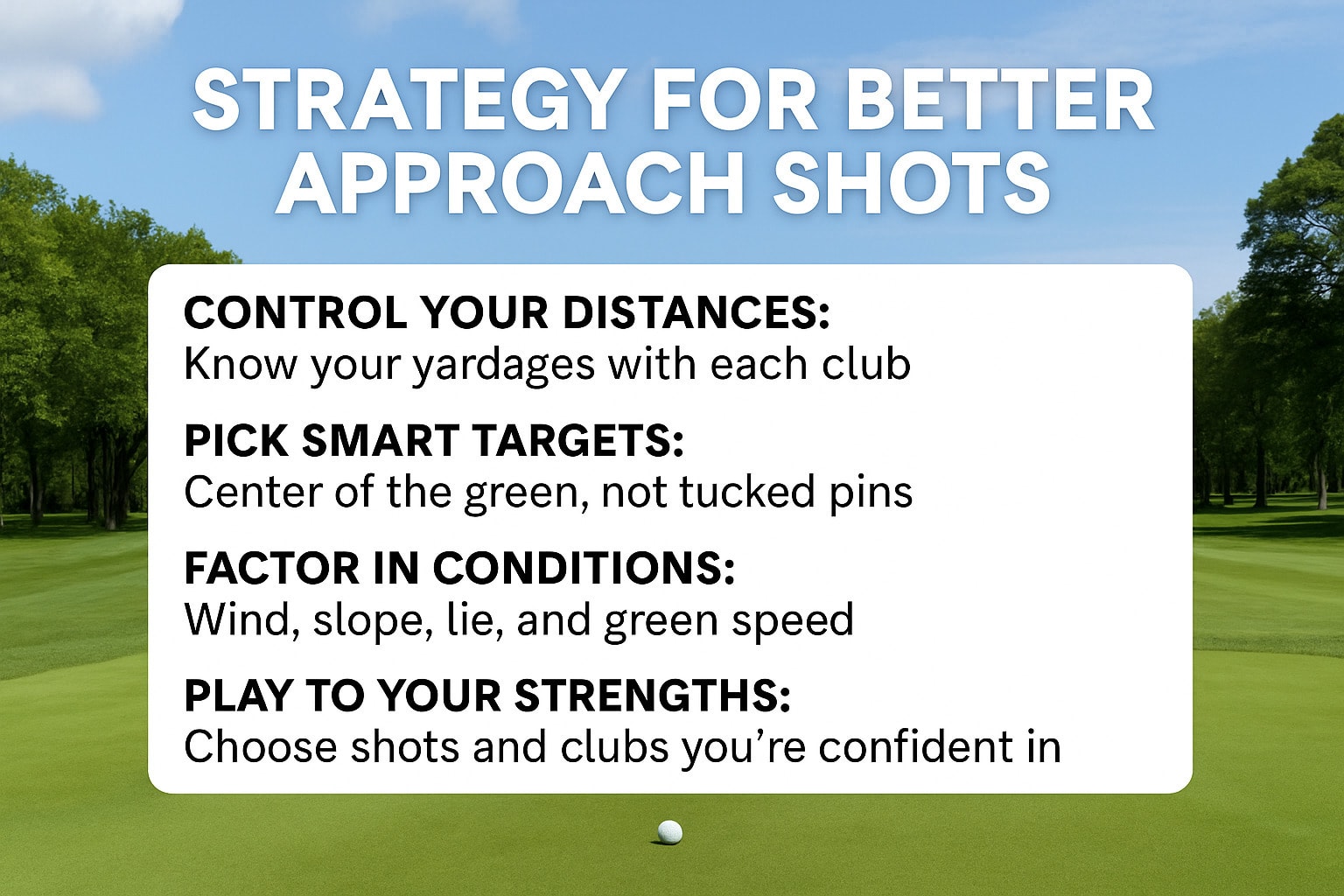
Control your distances: Know your yardages with each club and practice hitting consistent numbers.
The reason distance control is so valuable is simple: most amateur misses come from shots that are too long or too short, not left or right. When you know how far your clubs actually go, you give yourself a real chance to hit greens consistently.
Pick smart targets: Center of the green is usually safer than flag hunting, especially with hazards nearby.
Aiming for the center of the green may feel boring, but it’s the secret to lower scores. Flags are often tucked behind bunkers or near edges, going straight at them brings double bogey into play. A safe middle target usually leaves you with a putt, and two putts for par beats scrambling from the rough.
Factor in conditions: Wind, slope, lie, and green speed all affect how the ball reacts.
Factoring in wind, slope, and lie separates smart golfers from frustrated ones. A ball hit uphill into the wind needs more club, while a downhill lie might fly lower and run farther. Adjusting for these details makes your approach shots reliable instead of guesswork.
Play to your strengths: Choose shots and clubs you’re confident in, not just what looks best.
Finally, playing to your strengths matters because golf rewards confidence. If you’re better with a controlled 7-iron than a hard 8-iron, take the 7. Trusting the shot you know you can hit is often the difference between hitting the green and coming up short.
Common Mistakes in Approach Shots
The most common mistakes in approach shots are wrong club choice, chasing flags, bad distance control, ignoring conditions, and rushed swings. Here’s what they mean and how to avoid them:

1. Wrong club choice
What it is: Picking a club that doesn’t cover the true distance, leaving you short in a bunker or long over the green.
How to avoid it: Learn your yardages with each club. When unsure, take one more club and swing smooth.
2. Chasing flags
What it is: Going straight at tucked pins near hazards or edges, instead of aiming safely.
How to avoid it: Play for the middle or safe side of the green. A 20-foot putt is better than a penalty stroke.
3. Bad distance control
What it is: Shots flying too far or too short due to inconsistent contact or misjudged yardage.
How to avoid it: Practice wedge distances with drills, keep tempo steady, and check wind/elevation before swinging.
4. Ignoring conditions
What it is: Forgetting to adjust for slope, lie, wind, or green firmness, causing poor ball flight or rollout.
How to avoid it: Always read the lie and surroundings. Factor in slopes, wind direction, and where the ball will land and roll.
5. Rushed swings
What it is: Getting quick or anxious over the ball, leading to thin, fat, or off-target contact.
How to avoid it: Stick to a pre-shot routine. Breathe, pick a target, and make a smooth, committed swing.
Avoiding these common mistakes doesn’t require perfection. Just smarter choices and steady habits that make every approach shot more reliable.
Drills to Improve Approach Shots
The best drills to improve approach shots are the distance ladder drill, 3-ball drill, random target practice, and low-point control drill.

1. Distance Ladder Drill
- Place targets at 30, 50, 70, and 90 yards.
- Hit 5 balls to each target using wedges.
- Focus on controlled swings, not full power.
2. 3-Ball Drill
- Drop 3 balls at one spot.
- Hit the first ball short, the second to the middle, and the third long of the target.
- Repeat until you can control all three distances consistently.
3. Random Target Practice
- On the range, pick a new target for every shot (different distance each time).
- Use your rangefinder or markers to set the yardage.
- Go through your full pre-shot routine before each swing.
4. Low-Point Control Drill
- Draw a line on the turf with spray paint or use range markers.
- Place the ball just ahead of the line.
- Practice striking the ground slightly in front of the line for clean contact.
Practicing these drills regularly will make your approach shots more consistent and dependable on the course.
FAQs About Approach Shots in Golf
1. What counts as an approach shot in golf?
Any stroke played with the intent to reach the green and set up a putt is considered an approach shot.
2. Which clubs are best for approach shots?
Golfers typically use wedges, short irons, mid-irons, and sometimes hybrids or fairway woods, depending on distance.
3. How do I improve my approach shots?
Practice distance control drills, aim for the center of the green, and choose clubs you trust for consistent contact.
4. What’s the biggest mistake golfers make on approach shots?
Chasing flags too aggressively, this often leads to hazards or missed greens. Safer targets produce better scores.
5. Why are approach shots so important for scoring?
They determine greens in regulation (GIR). More greens hit means more birdie looks, fewer bogeys, and lower scores.
Get instant access to the PDF version of this article with additional resources and insights.