TL;DR
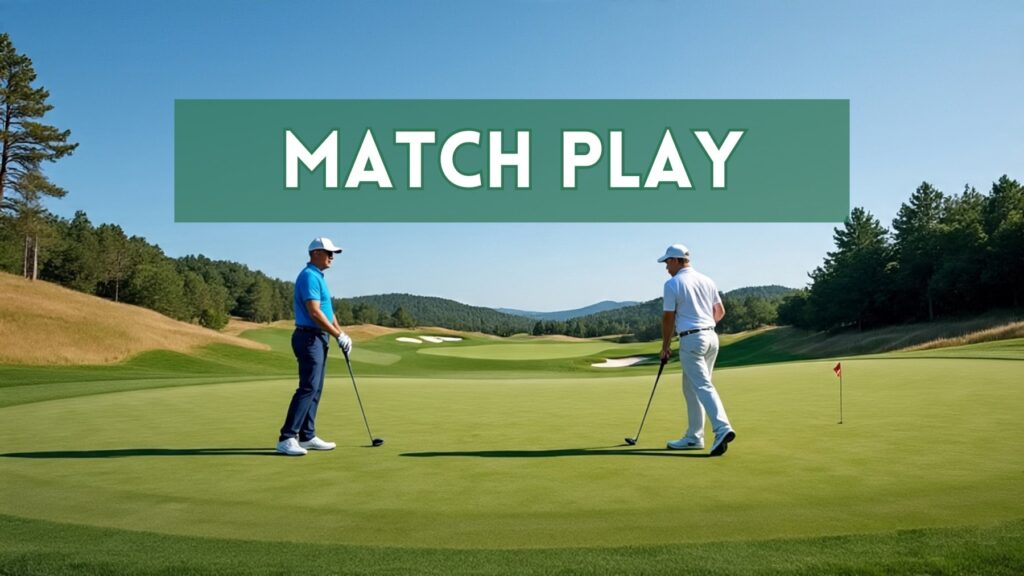
Match play is a head-to-head golf format where players win by capturing more holes than their opponent. It’s fast, strategic, and common in team events like the Ryder Cup.
Key Takeaways
- Match play is scored by holes won, not total strokes.
- Each hole is a separate contest, momentum resets every hole.
- Matches can end early when a player is up more holes than remain.
- Concessions (putts, holes, or matches) are allowed at any time.
- Common in events like the Ryder Cup and Presidents Cup.
- Handicap strokes apply hole-by-hole in amateur match play.
- Strategy depends on opponent position and match status, not total score.
What Is Match Play?
Match play is a golf scoring format where two players or teams compete hole by hole, and the goal is to win more holes than your opponent, not to shoot the lowest overall score. Instead of counting total strokes, each hole is a separate contest.
For example, if Player A scores a 4 and Player B scores a 5 on a hole, Player A wins that hole and goes “1 up” in the match. If they tie the next hole, the match remains “1 up.” The match ends when a player leads by more holes than remain.
This format is widely used in:
- Friendly games
- Amateur tournaments
- Professional events like the Ryder Cup, Presidents Cup, and WGC-Dell Match Play
Match play brings a more direct, competitive feel to golf, each shot can apply pressure, and momentum can shift quickly.

How Match Play Works
In match play, the outcome is decided by who wins the most holes, not by total strokes over 18 holes. Each hole is its own battle, whoever takes fewer strokes on a hole wins that hole.
Scoring Basics:
- Win a hole: You go 1 up.
- Tie a hole: The hole is halved—no change in the match score.
- Lose a hole: You go 1 down.
- Overall goal: Be more holes up than the number of holes left to play.
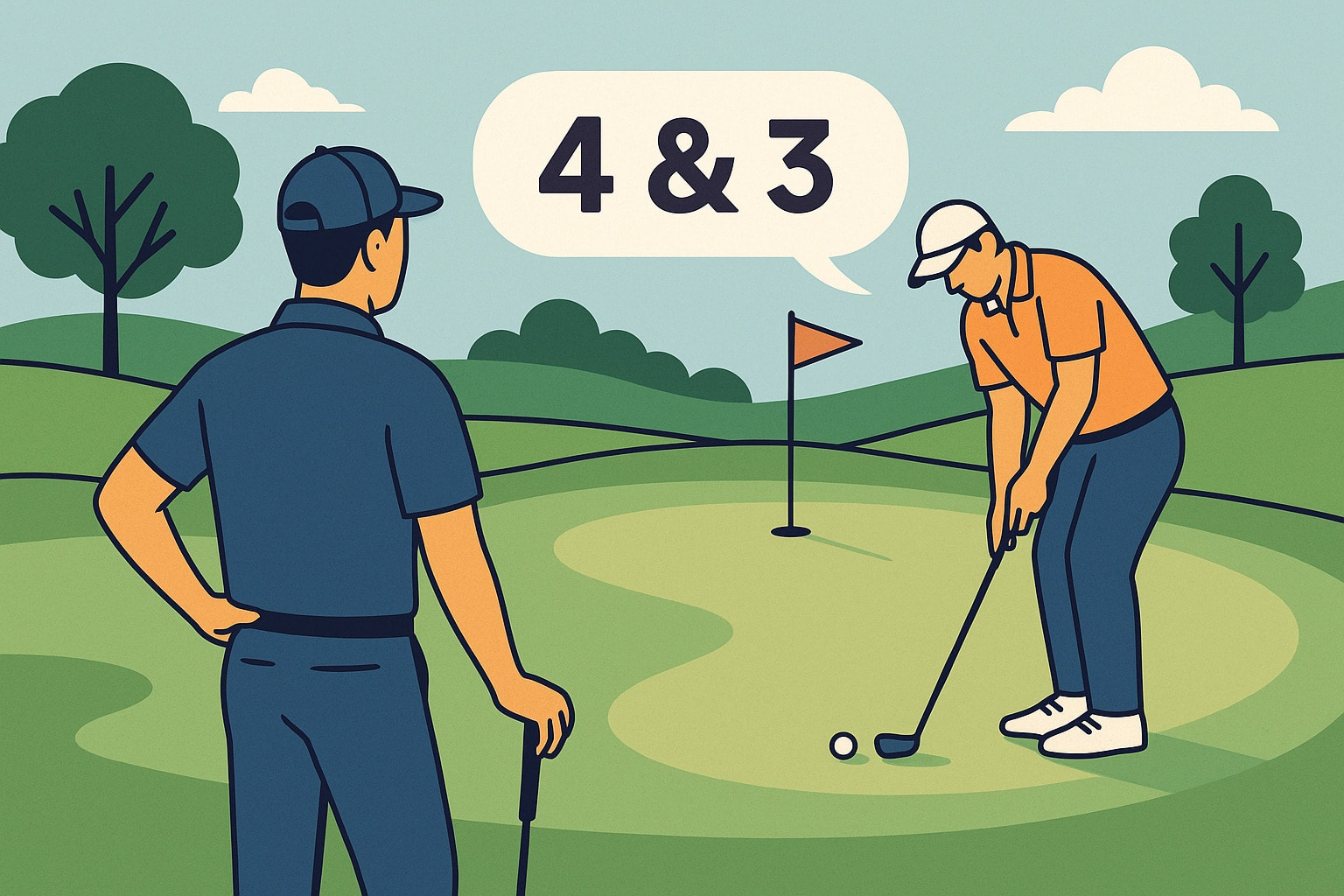
For example, if you’re 3 up with 2 holes to go, the match ends—you’ve won “3 & 2”.
Common Match Play Terms:
- 1 up / 2 up: You’re ahead by 1 or 2 holes.
- All square: The match is tied.
- Dormie: You’re up by the exact number of holes left (e.g., 2 up with 2 to play).
- Concession: You can concede a stroke, a hole, or the entire match at any time.
When Does the Match End?
- A match can finish before the 18th hole.
- If one player is leading by more holes than remain, the match ends early (e.g., 4 & 3 means 4 holes up with 3 to play).
This format rewards momentum and mental toughness. Every hole is a reset, making match play unpredictable and intense.
Key Rules Specific to Match Play (Rule 3)
a. Result of Hole and Match
You win a hole by completing it in fewer strokes, receiving a concession, or if your opponent loses the hole by penalty.
A hole is halved (tied) if both players complete it in the same number of strokes.
You win the match by leading more holes than remain, receiving a concession, or if your opponent is disqualified.
Tied matches can go to sudden-death playoff holes if a winner must be determined.
b. Concessions
You may concede your opponent’s next stroke, a hole, or the entire match.
Concessions are final and cannot be declined or withdrawn once made.
c. Handicaps in Match Play
Declare handicaps before the match starts.
- If you declare a too-high handicap and it affects strokes given, you are disqualified.
- If your declared handicap is too low, there is no penalty.
Handicap strokes are applied per hole, including playoff holes if needed.
d. Player Responsibilities
You must:
- Report your stroke count when asked.
- Inform your opponent of any penalties as soon as possible.
- Know and track the match score.
You may enforce or ignore your opponent’s penalty.
- However, if you both agree to ignore a penalty you know applies, you are both disqualified.
In case of disagreement, you can request a ruling to protect your rights.
You can read the full rules under Rule 3 – Match Play at the USGA site:https://www.usga.org/content/usga/home-page/rules/rules-2019/players-edition/rule-3.html
Match Play vs Stroke Play
Match play and stroke play differ in several key features, including scoring, focus, opponent structure, comebacks, strategy, concessions, and whether the match can end early.
| Feature | Match Play | Stroke Play |
|---|---|---|
| Scoring | Based on holes won | Based on total strokes |
| Focus | One hole at a time | Cumulative performance |
| Opponent | You play against one player or team | You play against the entire field |
| Comebacks | Always possible on the next hole | Harder after a big mistake |
| Strategy | Can be aggressive or defensive per hole | Requires consistent scoring |
| Concessions | Allowed (putts, holes, or match) | Not allowed |
| Early Finish | Possible (if you’re up enough) | Always played through all holes |
Match play rewards hole-by-hole performance, mental toughness, and adaptability.
Stroke play tests consistency and endurance across the entire round.

Common Match Play Strategies
Key match play strategies include playing aggressively when behind, playing conservatively when ahead, reading your opponent’s position, conceding wisely, controlling momentum, and knowing when to press or protect.

Play aggressively when behind
Take calculated risks when trailing, you need to win holes to catch up.
Play conservatively when ahead
Minimize mistakes and let your opponent take the risks when you’re leading.
Read your opponent’s position
Adjust your shot based on where your opponent is, attack when needed, play safe when they’re struggling.
Concede wisely
Giving short putts can be strategic, but don’t overdo it in a tight match.
Control the momentum
Winning back-to-back holes can swing the match, stay mentally sharp and ride the wave.
Know when to press and when to protect
Make decisions based on the match status, like going all-in when dormie or playing smart when 1 up on 17.
Stay flexible, stay focused, match play rewards smart decisions and the ability to adapt under pressure. Every hole is a fresh opportunity to turn the tide.
Popular Match Play Events
Famous match play events in golf include the Ryder Cup, Presidents Cup, WGC-Dell Technologies Match Play, and U.S. Amateur Championship. These tournaments showcase high-stakes, head-to-head golf at its finest.
Ryder Cup
A biennial team event between the United States and Europe. It’s the most iconic match play competition in the world, featuring foursomes, fourball, and singles matches.
Presidents Cup
Similar format to the Ryder Cup but pits the U.S. against an International Team (excluding Europe). Played every two years in non-Ryder Cup years.
WGC-Dell Technologies Match Play
An individual PGA Tour event that featured a bracket-style format with the world’s top-ranked players going head-to-head. The event was last played in 2023 and has since been discontinued, making it the final official match play event on the PGA Tour schedule.
U.S. Amateur Championship
The most prestigious amateur event in the U.S. The tournament uses stroke play for qualifying, followed by a match play knockout bracket.
Solheim Cup
The women’s equivalent of the Ryder Cup, featuring Team USA vs Team Europe in a match play team format.
These events highlight how match play brings drama, strategy, and momentum shifts that aren’t always present in traditional stroke play formats.
Pros and Cons of Match Play
The pros of match play include faster pace of play, head-to-head excitement, comeback potential, strategic variety, and suitability for team formats.
The cons include early match endings, limited use in large fields, less individual recognition, and fewer appearances in pro events.

Pros of Match Play
- Faster pace of play: Matches can end early when one player is ahead by more holes than remain.
- Head-to-head excitement: Direct competition adds tension and focus to every shot.
- Comeback potential: A blow-up hole only costs one point—you can recover quickly.
- Strategic variety: Encourages aggressive or defensive play based on match status.
- Great for team formats: Perfect fit for events like the Ryder Cup, Presidents Cup, and Solheim Cup.
Cons of Match Play
- Early match endings: Matches can end well before 18 holes, reducing total play time.
- Not suited for large fields: Single-elimination brackets don’t scale well in big tournaments.
- Less individual recognition: A great personal round might still lose if the opponent is better that day.
- Rare in pro tours: Most televised and pro events still favor stroke play formats.
Common Mistakes in Match Play
Common match play mistakes include losing track of the match score, playing too aggressively too early, ignoring your opponent’s position, conceding carelessly, and forgetting that total strokes don’t matter.
Losing track of the match score
Match play depends on knowing if you’re up, down, or all square, don’t rely solely on memory.
Playing too aggressively too early
Taking big risks from the start can backfire, pace your strategy based on the match flow.
Ignoring your opponent’s position
Don’t play blindly, if your opponent is in trouble, you can play safe and still win the hole.
Conceding carelessly
Giving away too many short putts can lose holes, use concessions strategically, not automatically.
Thinking like it’s stroke play
Total strokes don’t matter. You can win a match with more strokes overall if you win more holes.
Stay sharp, stay aware. Match play rewards smart thinking, strategic focus, and learning from every hole. Avoiding simple mistakes can be the edge you need to win.
Match Play in Team Formats
Match play is commonly used in team formats like Fourball, Foursomes, and Greensomes, where strategy, teamwork, and shot selection become even more important. These variations create exciting dynamics and are featured in many international team events.
Fourball (Best Ball)
Each player plays their own ball, and the team’s best score on each hole is used. Matches are decided by the better ball from each side.
Foursomes (Alternate Shot)
Two players share one ball and alternate shots. One tees off on odd-numbered holes, the other on even ones. It’s highly strategic and demands excellent coordination.
Greensomes
A hybrid of Fourball and Foursomes: both players tee off, then the team chooses the best drive and plays alternate shot from there.
Team Match Play Strategy Tips
- Pair players with complementary strengths (e.g., long hitter + short game expert).
- Maintain clear communication on club selection, target lines, and strategy.
- In alternate shot formats, manage rhythm and mindset—each shot affects your partner.
- Play smart when one teammate is in trouble—minimize risk to keep the hole alive.
FAQs About Match Play
What is the main difference between match play and stroke play?
Match play is scored by holes won, while stroke play is based on total strokes over the entire round.
Can a match end before 18 holes?
Yes. A match ends when one player or team is up more holes than remain, such as winning “4 & 3”.
Are concessions allowed in match play?
Yes. Players can concede a stroke, hole, or the entire match at any time. Conceded putts are considered holed.
Does total score matter in match play?
No. You can shoot a higher total score and still win the match by winning more holes.
Is match play used in professional tournaments?
Yes, but it’s less common. High-profile events include the Ryder Cup, Presidents Cup, and U.S. Amateur Championship.
Can you play match play with handicaps?
Yes. In amateur play, handicap strokes are applied on specific holes based on course handicap rankings.
Get instant access to the PDF version of this article with additional resources and insights.